The Laboratory · The room after the Path
You know the shapes.
The changes still get away from you.
You can play the scales. You know the theory. And then the tune moves, and you are running positions instead of playing the harmony. This is the room for that. Nine tunes and thirty lessons, one tune at a time. Inside Parker's solos and Powell's, taken apart bar by bar, until everything you already know starts flying. Not a course you finish. A room you work in.
If you have worked through the Fretboard Freedom Path, this is what comes next: the same fretboard, applied to real tunes. If you have not, you can still start here, as long as you know your triads.
$347 once, yours for life.
Or three payments of $116.14-day money-back guarantee. If it is not for you, write to me within 14 days and I refund the whole purchase, no questions asked.
Already have a WeissGuitar login? Walk through the Laboratory first. Everything is visible, and three lessons are open: Autumn Leaves, The Art of Inner Timing, and Five-Note Diatonic Arpeggios.
Lifetime access. 30 lessons plus 11 bonus live sessions. 17 hours of lessons, plus 15 hours 22 minutes of live sessions. A practice card on every one.
01 / Why a laboratory
Finishing was never
the point.
Most courses are a staircase. Lesson one, lesson two, a progress bar, a certificate. That is fine for learning a scale. It is the wrong shape for learning to play through Cherokee. Nobody ever got Cherokee by watching it once and moving on. You get it by staying on it, looping the bridge, transcribing one phrase, playing it every day for two weeks until the changes stop being a chart and start being a sound you can hear coming.
Two weeks on Cherokee, for example
- Watch One-Position Arpeggio Flow once, guitar in handEvery arpeggio in the tune from one spot on the neck. Short, and the thing that makes the bridge playable.12 min
- Then Modern Jazz PhrasingAltered lines and modern phrasing over the whole form. Stop the video every time something catches your ear.52 min
- Run the practice card every dayWarm-up, focus, ears. Ten to twenty minutes. Same card, every day, until it gets easy.daily
- Steal one phrase, put it in three keysYour line, now. When it comes out on its own at a session, pick the next tune.week two
Every tune lab works this way. The order of the tunes is yours.
One tune, worked properly,
changes more than watching all of them.
- There is no order to keep and nothing to fall behind on. Start with Autumn Leaves, then you choose.
- The long sessions, Bud Powell, the Transcription Workshop, the bebop blues, the eleven bonus live sessions, are not meant to be watched through. They are meant to be returned to, a piece at a time, for years.
- Every lesson has a written practice card with a warm-up, a focus and an ears task. You always know what to do when you sit down.
02 / How it works
Four zones.
One way to use them.
The Laboratory is arranged by what a lesson is for, not by what number it is. Tune labs you enter in any order, starting with Autumn Leaves. Method studies you come back to. A workbench of short drills for the days you only have ten minutes. And, as a bonus, eleven live sessions on how you practice, hear and play.
Tune Labs
Autumn Leaves first, then Solar, Cherokee, Spain, Donna Lee, Confirmation, the bebop blues, Airegin and rhythm changes, in any order. Pick one. Stay with it for a couple of weeks. Then the next.
Studies
Method, not repertoire. How I learn a Parker solo, the full transcription process, harmonic storytelling, and why triads are the one source of truth.
The Live Room, a bonus of eleven live sessions
Recorded live with Academy members and left unedited. They run long, and students play and get feedback in them, so every one is chaptered: 187 marked moments across the eleven, and clicking one drops you inside the topic. In here as a bonus, for the days when a tune stops moving and you need to hear how I think about practicing.
Workbench
Two to twenty-three minutes each. Arpeggio flow, fourth stacking, altered navigation, diatonic mobility, a rhythmic challenge. Warm-ups that also teach.
03 / What is inside
All 30 lessons,
nothing hidden.
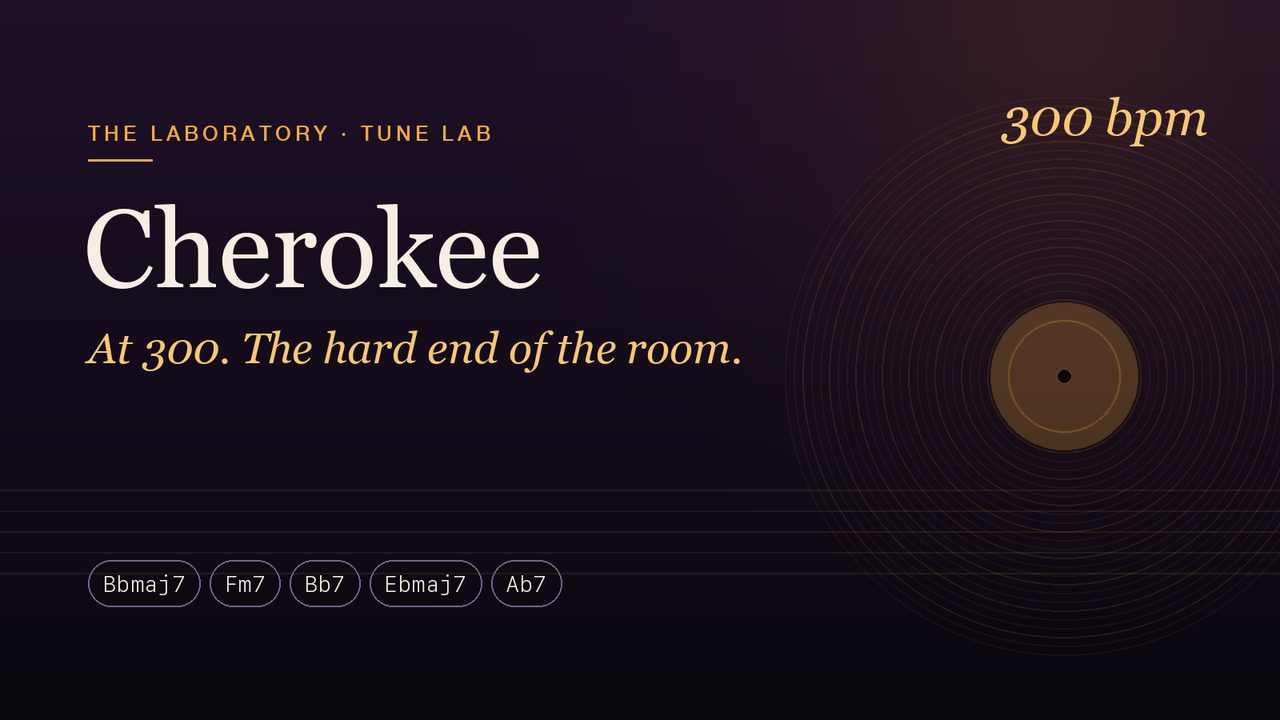
Cherokee at 300. One minute, so you can hear the hard end of the room before you decide.
Short lessons on single ideas, and long sessions where a whole tune or a whole solo gets worked through end to end, nothing edited out. Eight of them are live recordings, and so are the eleven bonus sessions; each one says so on its page. Every lesson has a written practice card, and most have PDFs.
01
Tune Labs
Nine tunes. Start with Autumn Leaves, then enter any of the others, and stay until it is yours.
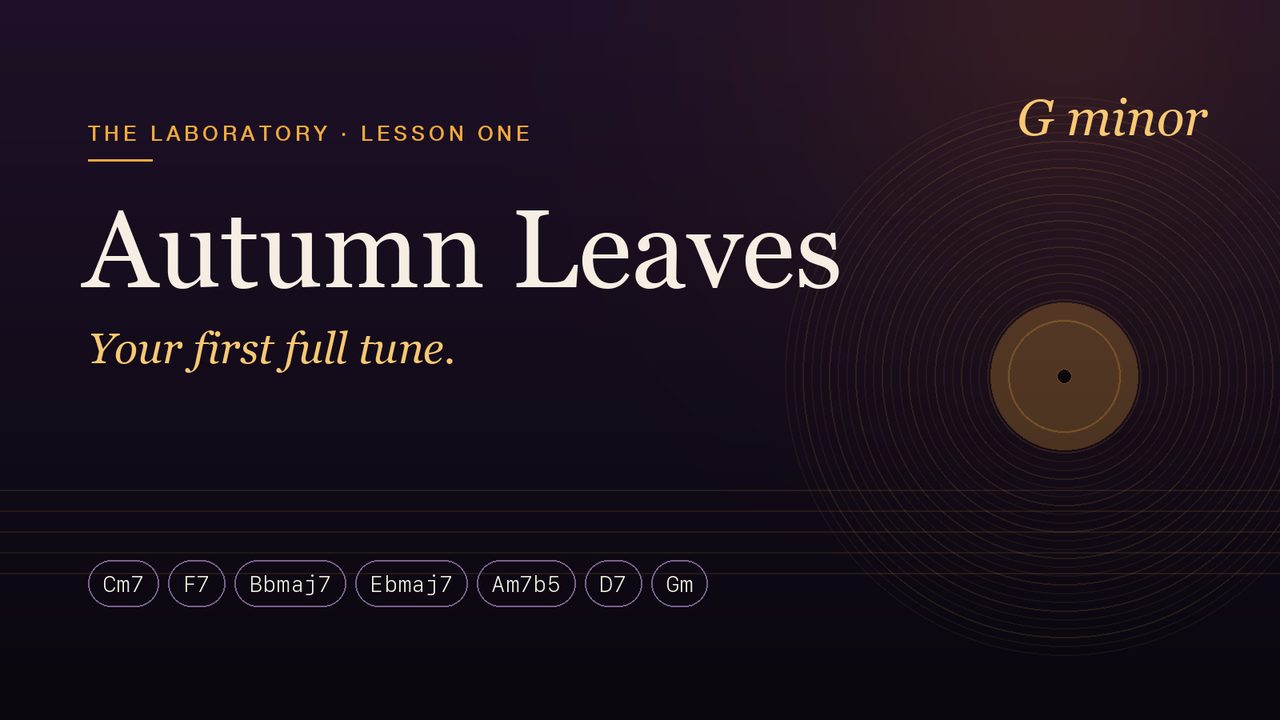
Autumn Leaves · Start here
Autumn Leaves: Soloing Essentials
Autumn Leaves in G minor, one of the best vehicles there is for connecting triads across changes. Your first full tune, and the one that shows you how every other lab in here works.
Solar
Solar: 10 Levels of Mastery
From roots to triads to voice leading to enclosures and modern intervals, in ten levels over one perfect set of changes.
Cherokee
Cherokee: One-Position Arpeggio Flow
Every arpeggio in the tune from one position. The thing that makes the bridge playable. Do this one first.
Cherokee: Modern Jazz Phrasing
A hard tune at tempo. This solo uses altered lines and modern phrasing, and we go through why each choice sounds like a choice.
Spain
Spain: Deep Dive
Chick Corea's Spain, one of my all-time favorite tunes. A deep harmonic analysis before you play a note.
Spain: How to Improvise + Solo
The levels system applied to Spain. From comping to soloing with triads, voice leading and enclosures.
Spain: Rhythmic Challenge
Sixteenth-note grid awareness. Time feel is the biggest weakness for most guitar players, and this is where it gets fixed.
Donna Lee
Donna Lee: Enclosures and Nested Melodies
Enclosing chord tones with chromatic and diatonic approaches. Tension that resolves beautifully.
Donna Lee: Nested Melodies Part 2
Deeper into nested melodies. Advanced enclosure patterns over real changes.
Donna Lee Solo (Parker) Pt.1
A beautiful example of how bebop elements connect over standard changes, through Parker's own solo.
Donna Lee Solo (Parker) Pt.2
Second chorus. The same motivic ideas evolving across the form.
Confirmation
Confirmation: Into The Bop
Parker's Confirmation broken down. Bebop vocabulary, chromaticism and motivic development.
Bebop Blues "Perhaps"
Bebop Blues "Perhaps" (Parker) recorded live
Parker's solo on the blues, played for you at full speed and again at half speed, with the transcription, and then the two-hour session where the whole solo gets taken apart chorus by chorus.
Airegin
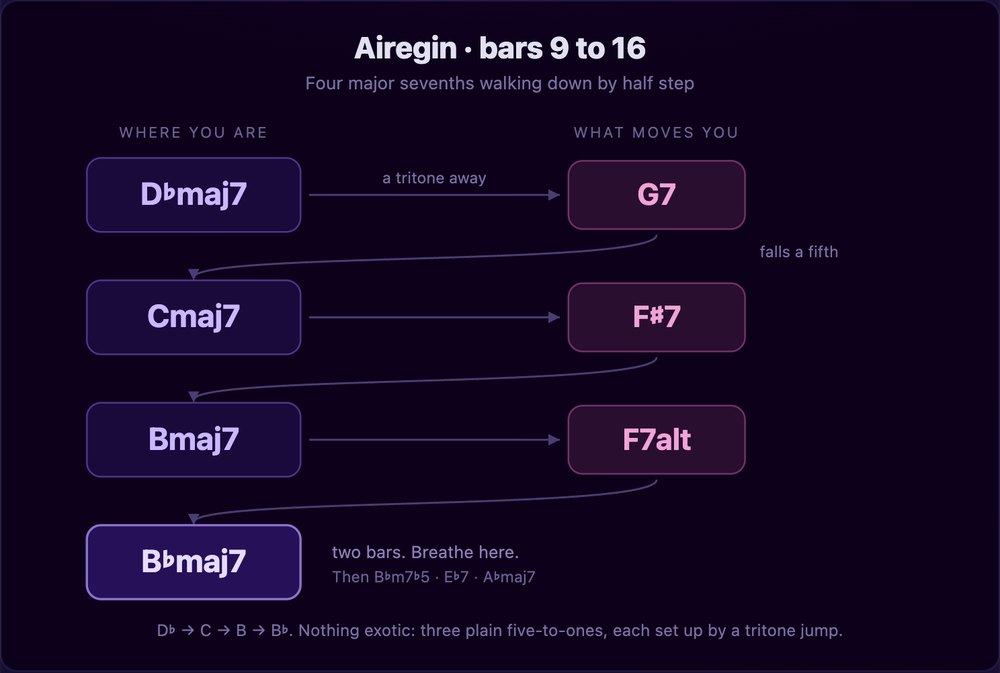
Chris Potter on Airegin: the solo, and the transcription
Potter's two choruses on the Rollins tune, played at tempo with the notation running underneath, plus the four-page transcription and a walk through the harmony: thirty-six bars, and four major sevenths walking down by half step.
Rhythm Changes
Rhythm Changes: Guide Tones + Solo
Bb rhythm changes with guide tones you can hear, not shapes you memorized. Solo analysis and exercises.
Bud Powell Session 1 recorded live
Powell's piano vocabulary adapted for guitar. Rhythmic precision, harmonic clarity, bebop phrasing.
Bud Powell Session 2 recorded live
Deeper into Powell. Rhythmic displacement, substitution, octave displacement.
02
Studies
Method first, notes second. These are the lessons that make every future tune cheaper to learn.
How I Learn a Parker Solo (Ornithology) recorded live
The first ten bars of Ornithology as the example. The exact process, so you can do the next one without me.
Transcription Workshop recorded live
The full transcription methodology: how vocabulary gets into your playing so that it becomes automatic.
Harmonic Storytelling recorded live
Learning solos as stories, not fret numbers. What the soloist is telling over the harmony, and how to tell your own.
One Source of Truth recorded live
Why triads and voice leading are the one source of truth. Everything that sounds advanced is an expansion of triads you already know.
03
The Live Room, a bonus of eleven live sessions
These were recorded live with Academy members and left unedited. They run long, they wander a little, and students play and get feedback in them. That is what a live session is. They are in here as a bonus, for the days when a tune stops moving and you need to hear how I think about practicing.
Deep Practice recorded live
What a practice session looks like when it actually changes your playing. Fewer things, slower, with your ears switched on.
Mastery is Awareness recorded live
Mastery is not speed. It is knowing where you are, what the chord is, and what you are about to play, before you play it.
Diminished Meditations recorded live
The diminished sound, slowly. Where it lives in a dominant chord and how to sit inside it until it stops sounding strange.
Modern Pentatonic Lines recorded live
The scale you already know, upgraded. Pentatonic shapes moved through changes so they sound modern instead of safe.
Practice as Performance recorded live
The Carnegie Hall approach. Play every exercise as if it mattered, because the way you practice is the way you will sound.
Depth Over Breadth recorded live
Why going deep on one idea beats skimming ten, and how to choose the one idea worth going deep on this month.
The Art of Inner Timing recorded live
Time feel from the inside. Where the pulse lives in your body, and how to keep it there when the changes get busy.
Masterclass recorded live
A full masterclass: playing, questions and feedback, worked through in real time. The closest thing here to a lesson in the room.
Finding Your Voice recorded live
Sounding like yourself instead of your influences. What to keep, what to let go of, and how to hear the difference.
Into the Deep Water recorded live
Past the material you feel safe with. Improvising over changes when you no longer have a shape to hold on to.
04
Workbench
Short drills for the days you have ten minutes. Each one warms you up and teaches something at the same time.
Five-Note Diatonic Arpeggios
Arpeggios that run past the octave, so a line keeps going where a shape would stop.
One Position Arpeggio Flow
Every diatonic arpeggio without leaving one position. Seeing the harmony under your hand.
Fourth Stacking Mastery
Stacked fourths across the string sets. The modern, open sound, built from what you already know.
Diatonic Mobility (G Major)
Moving through one key across the whole neck without jumping positions.
Altered Navigation Matrix
A two-minute map for finding the altered sound on any dominant chord.
Altered Navigation Matrix Pt.2
The same map, extended.
Exploring Freedom
Constraints that breed ideas. One string, one triad, one idea, and see how far it goes.
10 Levels of Soloing With Minor Triads
The levels system with minor triads. From the plain triad to lines that sound modern.
Rhythmic Challenge #1
One exercise that improves your technique, your time and your sound at once.
04 / Four ways in
Start where
the problem is.
Nobody needs all of this at once. Here are four routes through the Laboratory, each one built around a specific problem I hear from players every week. Pick the one that sounds like you, and ignore the rest until it is done.
Play through changes
You run scales over the harmony instead of playing it. The route: Autumn Leaves, then Solar, then both Cherokee lessons, the arpeggio flow first and the phrasing after it.
For the player who gets through a tune but can hear themselves surviving it.Steal Parker's language
You know the theory and your lines still do not sound like the records. The spine of the route: all four Donna Lee lessons and Confirmation, then the Ornithology study.
For the player recycling the same bag of licks.Rhythm changes, deep
The form every jam calls, and the one most guitarists fake. The route: guide tones and the solo, then both Bud Powell sessions.
For the player who wants one form they can never be caught out on.Learn any solo yourself
You want the method, not more material. The route: all four studies. Parker, transcription, storytelling, one source of truth.
For the player who wants to stop needing a course for the next tune.Four ways in. Whichever one you take, the others are still there when you come back.
05 / Be honest with yourself here
Who this is for.
And who it is not.
This is the deep end. It assumes a fretboard foundation that most people who buy it built with me on the Fretboard Freedom Path, and it does not stop to rebuild it.
This is for you if
- You know your triads across the neck and you can voice lead through a ii-V without thinking about it.
- You want to actually play through Cherokee, Donna Lee, rhythm changes and the blues, not just understand them.
- You are ready to sit with one tune for two weeks instead of watching ten videos in an evening.
- You want to learn how to take a solo off the record yourself, so the next one does not need a course.
This is not for you if
- You are a beginner, or you have been playing for years but mostly in one pentatonic box.
- You have not yet connected triads on the fretboard. Start there, on the path. This will overwhelm you otherwise, and I would rather you did not buy it.
- You want a course you can finish in order and tick off. This one does not work like that.
If you are somewhere in between, write to [email protected] and tell me what you can play. I will tell you honestly whether this is the right next step.
06 / What students say
Not my words.
Theirs.
A short compilation of reviews from WeissGuitar students, and below it a wall of messages exactly as they arrived. Nothing rewritten, nothing tidied up.
“I studied classical guitar performance for four years at university and also took some jazz theory classes. I know my theory. Yet I'm watching your videos and soaking up a wealth of knowledge.”Howard Vandermark, playing for almost 35 years


“Some people are great musicians, and other people are great teachers. But you, my friend, have both skills, and I really appreciate it.”
07 / Get it
One payment.
Years of work.
It sits on learn.weissguitar.com with everything else you own, in the same place, with your progress saved. Open it, start with Autumn Leaves, and then pick your next tune.
There is no discount on this page and the price will not move. It will still be here if now is not the right time.
14-day money-back guarantee
Work a tune properly. If it is not for you, write to [email protected] within 14 days and I will refund the whole purchase, no questions asked. Two weeks is enough to work one tune properly, and that is enough to know.
The Laboratory
- 30 lessons in three zones, Tune Labs, Studies, Workbench, plus 11 bonus live sessions
- 17 hours of lessons, plus 15 hours 22 minutes of live sessions
- 9 tunes worked end to end: Autumn Leaves, Solar, Cherokee, Spain, Donna Lee, Confirmation, the bebop blues, Airegin, rhythm changes
- A written practice card on every lesson: warm-up, focus, ears
- PDFs on most lessons, yours to print and keep
- Lifetime access, no subscription. One payment or three.
$347 once, yours for life.
Or three payments of $116.Instant access. Added to your existing library.
Who is teaching it
Daniel Weiss
Guitarist, educator and composer, working in jazz, fusion and progressive rock. Berklee trained, twenty years of teaching, and more than 5,000 students around the world.
The Laboratory is the material I use with my own students once their fretboard foundation is in place. It exists because the same thing kept happening in lessons: a player who knows the theory, can see the triads, and still cannot get through Cherokee without sounding like they are surviving it. The fix was never more information. It was one tune, worked properly, and then the next.
08 / Before you buy
Fair questions.
If yours is not here, write to [email protected]. It reaches me, not a support desk.
Do I have to go through it in order?
No, and please do not try. Start with Autumn Leaves, the shortest full tune in here and the best one for connecting triads across changes. After that, pick a tune and stay on it for a couple of weeks. The studies, the sessions and the workbench are there whenever you want them. Nothing unlocks on a timer and there is no progress bar to chase.
Do I need the Fretboard Freedom Path first?
You need what it teaches: triads across the neck in every inversion, and voice leading through changes. If you built that with me on the path, you are ready. If you built it somewhere else, you are also ready. If you have not built it yet, this is the wrong place to start, and I would rather you began on the path than bought this and got stuck in the first tune.
How long is it, and how long will it take?
30 lessons and 17 hours 21 minutes of video, plus 11 bonus live sessions that add another 15 hours 22 minutes. But that is the wrong number to plan around. A tune lab is between 8 minutes and 3 hours 20 minutes of video, and the work is the two weeks you spend on it afterwards with the practice card. Most players will be inside this for a year or more, and that is the intention.
Is this the Improvisers Academy material?
The teaching is, and I want to be straight about that. The lessons came out of the Improvisers Academy. What is new is everything around them, and it took months: they are arranged into zones by what a lesson is for instead of by date, every one of the thirty has a written practice card that did not exist before, the eleven live sessions have been chaptered so you can click straight to the moment you need instead of scrubbing through two hours, and the whole thing sits in your library with your practice log and day count on each tune. If you are an Academy member you already own all of it, and you do not need this. The Academy keeps what the Laboratory does not have: a new live session every month, and the community. The Laboratory is for players who want the tunes, the method and the recorded sessions without a membership.
Are these edited lessons?
The tune labs and the workbench are edited lessons. Eight of the tune-lab and study lessons, and all eleven bonus sessions, are live recordings, and each one says so on its page. The practice card under every video is written and edited for all of them, so you always know what to do with what you just watched.
Do I get the PDFs and practice cards?
Every lesson has a written practice card on its page: a warm-up, a focus and an ears task, so you always know what to do when you sit down. Most lessons also have a PDF with the notation and tabs, and those are yours to download, print and keep. The videos stream rather than download.
Is it really lifetime access?
Yes. One payment, no subscription, no renewal. It lives on learn.weissguitar.com alongside anything else you own, with your progress saved, on your phone, tablet or computer. Every video can be slowed down for practice.
What if it is not for me?
Write to [email protected] within 14 days and I will refund the whole purchase, no questions asked. I have never made that difficult for anyone and I am not going to start.
Pick a tune. Stay with it.
Nine tunes, four studies, a workbench of drills, and eleven bonus live sessions. Not to finish. To work in.
Get the Laboratory, $347Lifetime access. Added to your library the moment you pay. 14-day money-back guarantee.