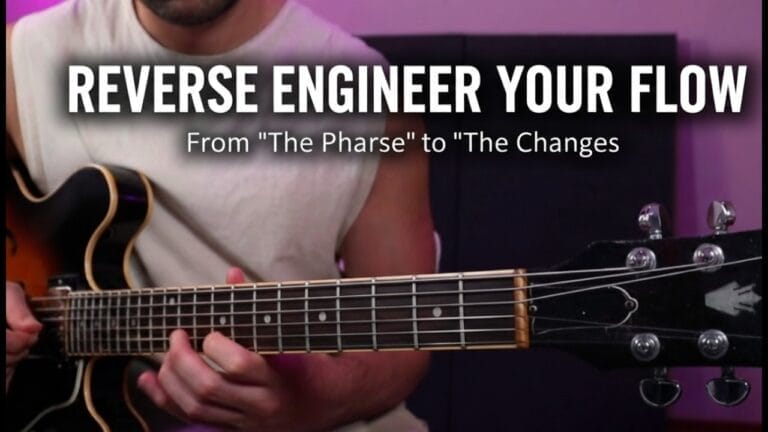
To play cleanly at 300 BPM, stop alternate-picking every note. Mix hammer-ons and pull-offs into your lines so your right hand stays relaxed. Think horn player, Scofield, Holdsworth, not raw speed. The rest of this article shows exactly how I did it.
I invite you to explore my Galactic Modern Guitar program, linked in the description below, for guidance and resources to solidify your harmonic and melodic knowledge, and to work on your technique in a musical way.
If you’re interested in a great arpeggio workout, click this video:
01 What’s the secret to keeping up with 300 bpm improvisations, while making it sound effortless and flowing?
When it comes to playing fast lines (300 bpm lol ) biggest breakthrough was realizing the way I want my playing to feel and sound.
This is the stuff that changed everything for me. The Fretboard Freedom Path shows you how technique and sound work together – none of this compartmentalized practice.
for me, it’s all about how I’m imagining my lines!
What would they sound/feel like? How can I execute them easily? How can I make them as comfortable as possible to play? -> Our goal is to get the sound we imagine into our fingers! For me, that means I always have to find the best ways to practice my lines, arpeggios and scales to get to that place!
You see, I wanted the technique and ability to control speed without sacrificing the quality of my phrasing.
I had to ask myself:
When do I use alternate picking? When Do I play legato and utilize hammer-ons and pull-offs? How many strings am I using for arpeggios? Am I a sweeper? In terms of sound, I knew what I like!
02 I guess I was going for that flute or saxophone phrasing sound.
As far as guitar players go, I enjoy listening to players like
John Scofield and Allan Holdsworth – who incorporate legato in such a musical way!
I wanted to find these Legato qualities in my own playing!
and In this video I show you my take on
How YOU can manifest EXACTLY that (in 300 bpm as well…).
About Daniel Weiss
Daniel Weiss is a Berklee-trained guitarist, praised by Jordan Rudess (Dream Theater), who has taught improvisation for 20+ years to 5,000+ students worldwide. More about Daniel
A structured roadmap that connects triads, arpeggios, and voice leading into one system. Every step builds on the last – so you always know what to practice next.
The fastest guitarists I know don’t actually pick every note. They pick one, hammer one, pull off one, then pick again. That rhythm of pick, slur, pick is what keeps the right hand relaxed at tempo. Alternate picking every note at 300 BPM forces both hands into a tension stack that kills the phrasing, and phrasing is the thing you actually hear.
For me personally, the moment I stopped trying to pick every note and started using legato as the default, two things happened: the lines sounded more like a saxophone and less like a guitar exercise, and my right hand stopped fighting me. That is the difference between a line that flows and a line that just moves fast.
Quick test. Take a C major arpeggio and play it with strict alternate picking at 240 BPM. Now play the same arpeggio picking only the first note of each triplet and hammering the other two. You will feel it immediately. The legato version has room to breathe, and that room is what makes 300 BPM possible.
The unlock
Speed is not a picking problem. It is a phrasing problem. Once you hear fast lines like a horn player hears them, breath, shape, direction, your hands start solving the technical side on their own.
L2 Alternate picking vs legato: when to use which
Legato is not better than alternate picking. They are different tools for different sounds, and the fast players I admire use both on purpose.
Reach for alternate picking when…
You want each note to speak with clear attack
You are playing across multiple strings without string skipping
You need rhythmic precision: funk, tight jazz rock, bebop with articulation
Reach for legato when…
You want horn-like, flowing phrasing (Scofield, Holdsworth)
Your line sits on one or two strings
You want the phrase to sound fluid, not mechanical
Most of my fast lines use both. I will alternate pick the first few notes to set the groove, drop into legato for the fluid part, then come back to picking for the resolution. The mix is the thing. Listen for where your lines breathe, that is where legato belongs.
Try this
Record yourself playing a fast line twice, once with strict alternate picking, once with hammer-ons and pull-offs mixed in. Listen back. The legato version almost always sounds more musical, even if the picked version is technically cleaner. That is the horn-player sound you have been chasing.
Frequently Asked Questions
03 How do I play fast arpeggios without getting a sweepy sound?
Skip strings in your arpeggio patterns instead of playing across all strings consecutively. This approach creates a smoother, more legato tone similar to horn players like John Scofield, rather than the typical sweep picking sound.
04 What’s the best right-hand technique for playing fast, clean lines at 300 BPM?
Anchor your pinky on the guitar body and use wrist-based picking with a tilted pick rather than a floating hand and flat pick. This provides much more control and a cleaner sound when executing fast passages.
05 Should I use hammer-ons and pull-offs or alternate picking for fast lines?
It depends on the sound you want – legato techniques like hammer-ons and pull-offs create a smoother, horn-like phrasing, while alternate picking offers more precision. Practice both approaches with C major triads and scales to discover which fits your musical style best.
06 How do finger choices affect playing fast chord changes smoothly?
Being aware of which fingers you use on each shape (like using your second and fourth fingers to transition between C major positions) helps you prepare for the next shape efficiently. This finger awareness reduces unnecessary movement and creates seamless, flowing transitions between arpeggios and scales.
Key Takeaway
In summary: Pick once, hammer on, then pick again. That legato approach makes everything flow at any tempo.
Daniel Weiss
Daniel Weiss is a Berklee-trained guitarist, praised by Jordan Rudess (Dream Theater), who has taught improvisation for 20+ years to 5,000+ students worldwide. More about Daniel: https://weissguitar.com/about/
Upgrade your playing in 5 weeks.
Stop random practicing. Get a proven step-by-step action plan + 5 exclusive video lessons, free to your inbox.