

Daniel Weiss holding his guitar

Hi, I'm Daniel Weiss.

Guitarist, composer and educator

I help guitarists connect what they hear, what they know and what they play.

My music brings together jazz, fusion and the energy of progressive rock. My teaching helps you explore those musical connections, so the things you practice become part of the music you make.

Daniel Weiss holding his guitar
Photo: Eran Shaysh

My story

Music was my way in

My father is a musician, and he was one of my first inspirations. I originally wanted to play drums. A neighbor had a guitar I could use, and that became my way in.

Rock guitar caught my imagination. My interests grew into jazz, fusion and composition, and the possibilities kept opening up.

I studied at Berklee College of Music and was a finalist in Guitar Idol 2016. Along the way, I've worked as a guitarist, composer and arranger, and made original music with other musicians.

Those experiences are part of what I bring to teaching. I'm interested in the sound of an idea, the choices behind a phrase, and what happens when musicians listen to each other.
My music

Hear the music

My albums Dive (2021) and The Vortex (2024) bring together my work as a guitarist and composer with the musicians I play alongside.

We recorded Dive in one long studio day. Much of its music was written with pianist Yaniv Taubenhouse. I love that part of making a record: an idea becomes something you can share and hear through other musicians.

Start with Pyramids, from The Vortex.

Pyramids
From The Vortex, 2024
Composed by Daniel Weiss. With Yaniv Taubenhouse, Sharon Petrover, Iggy Jackson-Cohen and Eyal Aizic.

Teaching

How I teach

A useful idea should give you something you can hear, practice and use.

We might begin with an A major triad: A, C sharp and E. Over an A7 chord, those notes give us a clear starting point.

Then we make a phrase. Play E, F sharp and A, and slide from C into C sharp. We've added the sixth and a bluesy approach to the third. Change the rhythm. Leave a little space. Sing it, then play it again.

From there, we can move the idea with the chords and explore what you can do with it.

That's the kind of connection I care about: understanding an idea well enough to make musical choices with it.

I use triads, scales, arpeggios, transcriptions and vocabulary throughout my teaching. We work on rhythm and phrasing alongside the notes, and apply ideas to tunes.

The purpose of an exercise should be clear. You should know what you're listening for, what you're working on, and where it fits in your playing.

A musician and a teacher

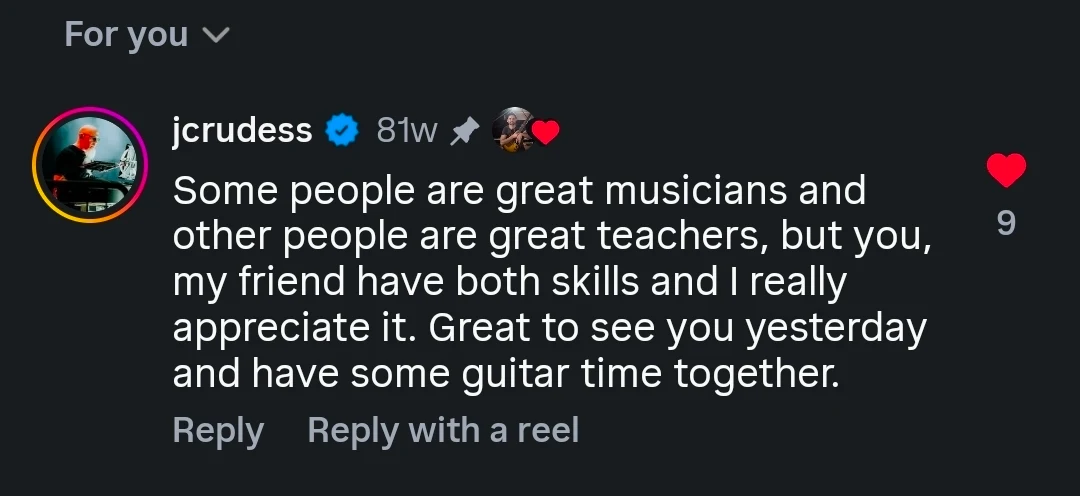
“Some people are great musicians and other people are great teachers, but you, my friend have both skills and I really appreciate it.”
Jordan Rudess, Dream Theater, in an Instagram comment after a guitar session together. Screenshot of Jordan Rudess's Instagram comment: Some people are great musicians and other people are great teachers, but you, my friend have both skills and I really appreciate it. Great to see you yesterday and have some guitar time together.

I've been teaching for more than 20 years, and I still think of myself as a student of music. There is always another sound to explore or another way to understand something familiar.

That curiosity matters in lessons too. Your questions and the music you want to play give us a direction.

Is this for you?

Make room for the music you want to play

You may already be a capable guitarist and want more freedom with the things you know.

Perhaps you'd like your phrases to connect more clearly through chord changes. Perhaps you want a stronger sense of rhythm, a wider musical vocabulary, or a clearer direction for your practice.

Your goals might be playing with friends, joining a band, recording your own music, or enjoying the guitar more at home.

You can take those goals seriously alongside work, family and the rest of your life.

Bring curiosity, room for regular practice, and a willingness to listen closely to your own playing.

Ways to learn

Find the right way to learn with me

Build a connected foundation

Fretboard Freedom Path

Six courses for independent study, with a clear sequence through fretboard foundations, harmony and improvisation. Work at your own pace and keep returning to the ideas as your playing develops.

Explore the Fretboard Freedom Path
Keep applying it to music

Improvisers Academy

Explore the Laboratory lessons, work with a new lesson each month, and join my monthly live session and Q&A. Recordings let you revisit the sessions in your own time.

Explore the Improvisers Academy
Not sure where to begin? Take the free guitar assessment Already learning with me? Log in to your courses