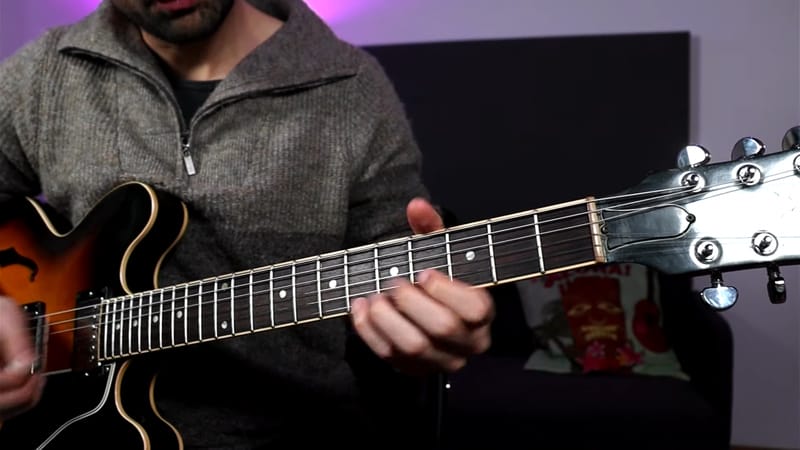
Adding Soul to Major Triads: A Guide to Dominant Chords
If you’ve been playing music for a while, you know that dominant chords are everywhere – from Blues to any style of Western music. Today, I’m going to show you a few steps to gain better control over them.
- Learn How to Manipulate Triads and Control Dominant Chords with These Simple Steps
- Frequently Asked Questions
- What makes a dominant chord different from a regular major triad?
- How do I find the flat 7 on the fretboard in different inversions?
- Can I approach dominant chord tones with bends and arpeggios?
- Why do C7 and E diminished share the same notes in certain inversions?
First, I’ll record a loop that goes like this:
Now, let’s look at the triads and where the seventh is located. The flat seven is key to our dominant sound. We have root, third, fifth, and the seventh. You can see that it’s a minor third above the fifth and its own below the root, so we get this:
In the first inversion, you can locate it either over here after the fifth:
Or you can see it on one string from the root. For example, B flat as the seven gives us:
And that’s the second inversion:
What you might notice is that with C7, you actually get both C and E diminished. Here’s the root position of C:
And the second inversion of E diminished:
You can learn more about triads on my website, wiseguitar.com, or check the link in the description. Here’s the first inversion, which can also be an E diminished:
You can approach any of these chord tones. For example, approaching the fifth from the sixth:
Or use an arpeggio to connect:
Try bending from the flat three to the three:
So, from D sharp or E flat to E:
Or bend from the minor third into the root:
Another approach could be blending in the fourth and second into the E:
You can manipulate a triad in many ways. This is just the beginning, and the possibilities are endless.
For a deeper dive into this, check out my Galactic Modern Guitar Program on my website, wiseguitar.com. The link is in the description.
Thank you for watching! If you want to see a cool video on minor triads, check out this video where I demonstrate some ideas on a minor vamp:
01 Learn How to Manipulate Triads and Control Dominant Chords with These Simple Steps
Dominant chords are everywhere in Western music, from blues to jazz to rock. If you’ve been playing music for a while, you know that these chords can add a lot of excitement and emotion to your playing. However, mastering dominant chords can be challenging, especially if you’re not familiar with the underlying structure of the major triad.
In this video, we’ll take a deep dive into the world of dominant chords and show you some simple steps you can take to have better control over them. We’ll start by looking at the root, third, fifth, and seventh of the major triad, and show you where the seventh is located. The flat seventh is the key sound of our dominance, so it’s important to understand where it fits in.
Here are the steps we’ll cover:
- Understand the root, third, fifth, and seventh of the major triad.
- Learn where the seventh is located.
- Manipulate triads to create interesting flavors in your playing.
- Approach chord tones to control dominant chords.
By understanding these steps, you’ll be able to add some soul to the major triads that are so essential to learn. You’ll have better control over dominant chords, and you’ll be able to create interesting flavors in your playing.