
Master Advanced Guitar Scale Patterns With Diatonic Movement & Chromatics
If you’ve been playing the C major scale for months but it still sounds like a robotic exercise rather than actual music, you’re facing the same frustration that keeps 80% of intermediate guitarists stuck in a creative rut. The problem isn’t your technique-it’s that nobody’s shown you how to break free from position-based thinking and transform those boring scale patterns into fluid, musical phrases that actually sound like the guitarists you admire.
For more on this, check out the pentatonic scale.
After 20+ years of teaching, I’ve discovered that mastering diatonic movement and strategic note groupings is the key to unlocking the entire fretboard. In this lesson, you’ll learn the exact system I use to help students move from playing scales to creating musical lines that flow effortlessly across the neck, using advanced concepts like 16th note groupings, chromatic approaches, and diatonic arpeggios that will revolutionize your improvisation within the first week of practice.
01 The 5 Essential Concepts for Advanced Guitar Scale Patterns
These patterns become musical when you connect them to triads – landing on chord tones turns a pattern into a phrase.
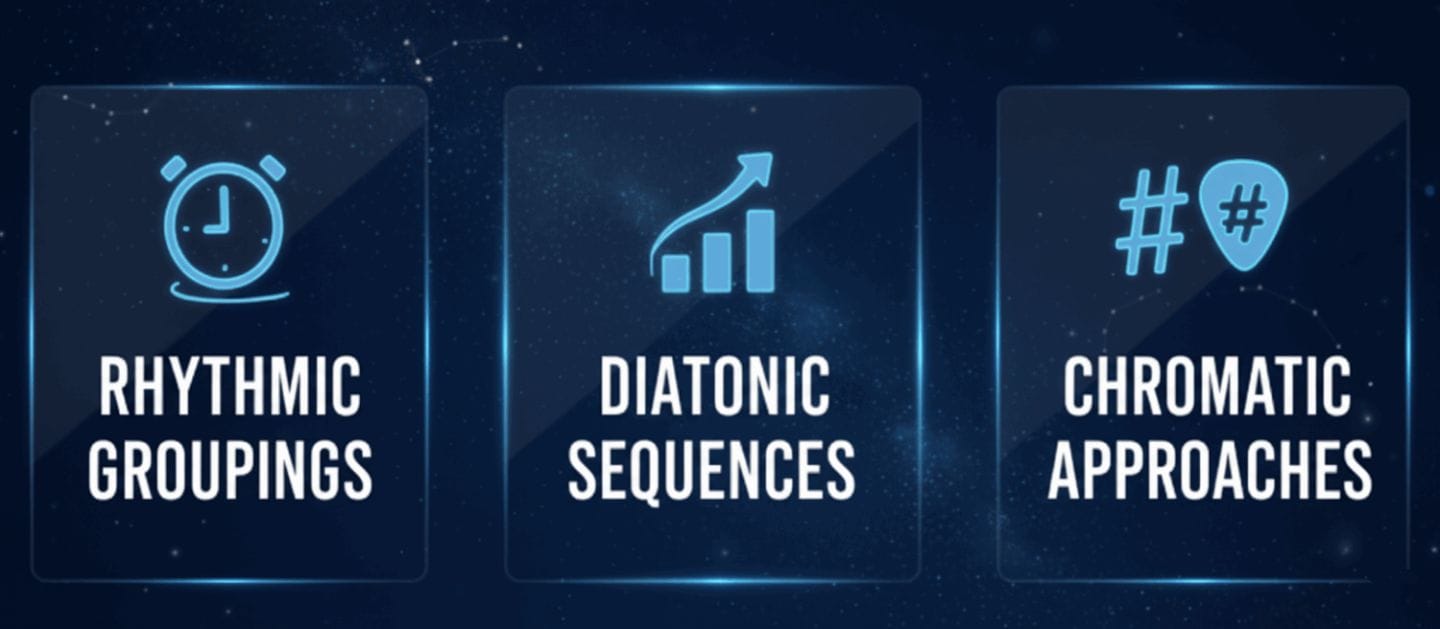
Transform your basic scale knowledge into fluid, professional-sounding phrases by mastering these five interconnected concepts that work together to unlock the entire fretboard.
1. Master 16th Note Subdivisions for Rhythmic Precision
The foundation of advanced phrasing starts with internalizing 16th note subdivisions. This isn’t about speed-it’s about creating a rhythmic grid that allows you to place notes intentionally rather than randomly. When you master this subdivision, every note has a specific rhythmic purpose, transforming mechanical scales into musical statements.
Week 1: Clap and count “1-e-and-a” for 5 minutes daily at 60 BPM
Week 2: Play C major scale in strict 16th notes, 10 minutes daily at 70 BPM
Week 3: Add accents on different beats while maintaining subdivision
Pro tip: Use a metronome app with subdivision clicks to internalize the feel
2. Implement Note Groupings of Five and Six
Breaking away from typical four-note patterns immediately makes your playing sound more sophisticated. Groupings of five create a floating quality over the beat, while groups of six provide rhythmic tension. The magic happens when you combine different groupings-like two groups of six followed by one group of five-creating unpredictable yet musical phrases.
Step 1: Count “1-2-3-4-5” repeatedly while playing 16th notes (3 minutes)
Step 2: Apply to A minor 7 arpeggio ascending (5 minutes daily)
Step 3: Combine with F major 7 arpeggio descending (5 minutes)
Expected outcome: Within 2 weeks, you’ll naturally hear and play in groups of five
3. Develop Diatonic Movement Across the Fretboard
Diatonic movement means taking any phrase or pattern and moving it through each degree of the scale while maintaining the scale’s harmony. This single concept exponentially multiplies your vocabulary-one lick becomes seven variations instantly. It’s the difference between knowing isolated patterns and truly understanding the fretboard.
Week 1: Choose a simple 4-note pattern, move it through C major (10 minutes)
Week 2: Apply to all seven arpeggios in the key (15 minutes)
Week 3: Connect positions using single-string visualization
Week 4: Combine with 5-note groupings for advanced sequences
Success indicator: You can play any arpeggio from any starting note
4. Strategic Chromatic Note Placement
Step 1: Identify whole steps in C major (F to G, etc.) – 5 minutes
Step 2: Practice adding chromatic notes between them – 7 minutes
Step 3: Apply to arpeggios (approach the root chromatically) – 8 minutes
Advanced: Use diatonic enclosures where half steps exist naturally
Timeline: Master basic chromatic approaches in 2-3 weeks
5. Connect Scale Positions Through Arpeggios
Arpeggios are the skeleton that connects all scale positions. By visualizing diatonic arpeggios (the seven chords built from each scale degree), you create mental highways between positions. This eliminates the “stuck in a box” syndrome and opens up the entire fretboard for fluid improvisation.
Week 1: Learn all seven diatonic arpeggios in position 1 (20 minutes)
Week 2: Connect to position 2 using common tones (15 minutes)
Week 3: Practice transitioning mid-phrase between positions
Week 4: Improvise using only arpeggios across 3 positions
Milestone: Play any arpeggio starting from any string within 1 month
02 25-Minute Daily Advanced Scale Pattern Routine
For a complete breakdown of how scales work across the neck, see the complete guitar scales guide.
Minutes 1-5: Subdivision Warm-up
- Clap 16th notes while counting groupings of 4, then 5, then 6
- Play C major scale ascending/descending in strict 16th notes
- Focus on evenness and timing, not speed
Minutes 6-12: Diatonic Arpeggio Sequences
- Play A minor 7 arpeggio in 5-note groupings (2 minutes)
- Move the pattern diatonically through all seven chords (4 minutes)
- Connect two positions using the same arpeggio pattern
Minutes 13-18: Chromatic Integration
- Practice F to G with chromatic passing tone (F-F#-G)
- Apply chromatic approaches to each arpeggio root
- Create 3 different chromatic patterns within C major scale
Minutes 19-25: Creative Application
- Improvise using only concepts practiced today
- Combine 5-note and 6-note groupings in one phrase
- Record yourself and identify successful moments
03 Advanced Performance Tips
Try This
Choose the D Dorian mode. Play it on two adjacent strings (A and D) using 4 notes per string. Create a sequence: play 4 ascending notes, go back to the 2nd note, play 4 ascending from there. Repeat up the scale. Then try the same pattern on the D-G and G-B string pairs.
Once you are comfortable with these patterns, start applying them to musical improvisation – that is where the real learning happens.
- Rhythmic Displacement: Start your 5-note groupings on different beats to create shifting accents that keep listeners engaged while maintaining your subdivision framework
- Dynamic Contrast: Use softer dynamics on chromatic passing tones and stronger attacks on chord tones to enhance the harmonic clarity of your lines
- Phrase Architecture: Build phrases using the concept of tension and release-use complex groupings to create tension, then resolve to simple quarter notes on strong chord tones
- Position Shifting Strategy: Never shift positions randomly; always aim for a specific target note in the new position and use chromatic approaches to make the transition smooth
- Motivic Development: Take a simple 5-note cell and develop it through repetition, inversion, and rhythmic variation rather than constantly introducing new material
- Breathing Space: Insert strategic rests between your grouped phrases-silence makes the complex rhythms more impactful and gives listeners time to process
- Harmonic Awareness: Always know which chord tone you’re targeting next, even when using chromatic notes or complex groupings-this keeps your lines grounded
- Practice Mental Singing: Sing your lines internally before playing them to ensure you’re creating musical phrases, not just executing patterns
Frequently Asked Questions
How long does it take to master diatonic movement on guitar?
What’s the difference between chromatic notes and passing tones?
Chromatic notes are any notes outside the current scale, while passing tones are notes (chromatic or diatonic) that connect two other notes smoothly. In the context of advanced scale patterns, chromatic passing tones specifically refer to non-scale notes used to approach chord tones or scale degrees. For example, using F# to connect F to G in C major. The strategic placement of these chromatic notes-typically between whole steps or approaching chord tones from a half-step below-transforms mechanical scales into jazz-influenced lines.
Why practice scales in groups of 5 when music is usually in 4/4 time?
Practicing in groups of 5 while maintaining 16th note subdivisions creates rhythmic tension that makes your playing sound less predictable and more sophisticated. The 5-note groupings float over the bar line, creating a polyrhythmic effect where your accents don’t align with the beat. After 2-3 weeks of practice, this becomes natural and you can switch between standard 4-note patterns and 5-note groupings at will, giving you more creative options during improvisation.
How do I practice arpeggios to connect different scale positions?
Start by learning all seven diatonic arpeggios in one position (C major 7, D minor 7, etc.). Spend one week on this until you can play them without thinking. Then identify common tones between positions-notes that appear in the same arpeggio but different positions. Use these as pivot points to transition smoothly. Practice playing the same arpeggio starting from different strings and positions. Within 4 weeks, you should be able to play any diatonic arpeggio from any starting position on the fretboard.
What mistakes do beginners make when learning advanced scale patterns?
The biggest mistake is trying to play too fast too soon, which prevents the neural pathways from forming correctly. Another common error is practicing patterns without understanding their musical application-knowing when and why to use specific groupings or chromatic notes. Many guitarists also neglect the rhythmic component, focusing only on notes rather than subdivision accuracy. Finally, practicing in isolation without applying concepts to actual musical contexts means the techniques don’t transfer to real playing situations.
What’s the fastest way to internalize 16th note subdivisions?
The fastest method combines physical and mental practice. Start by clapping and counting “1-e-and-a” for 5 minutes daily at a slow tempo (60 BPM). Simultaneously, use a metronome app with subdivision clicks to reinforce the feel. After one week, transfer this to your guitar using a single note, focusing purely on rhythm. By week two, apply it to scales. Most students internalize the subdivision within 14-21 days using this approach. The key is consistency-5 minutes daily is better than 30 minutes once a week.
04 Next Steps: Your 4-Week Transformation Plan
Week 1: Foundation Building
Master 16th note subdivisions at 70 BPM. Practice C major scale with strict timing for 10 minutes daily. Learn all seven diatonic arpeggios in first position. Begin counting and clapping 5-note groupings away from the instrument.
Week 2: Integration Phase
Apply 5-note groupings to the A minor 7 and F major 7 arpeggios. Start moving patterns diatonically through the scale. Add one chromatic passing tone between F and G. Increase practice to 20 minutes daily, recording yourself weekly.
Week 3: Advanced Application
Combine 5 and 6-note groupings in single phrases. Connect two positions using arpeggio patterns. Implement chromatic approaches to multiple chord tones. Begin improvising short 8-bar sections using only these concepts.
Week 4: Musical Implementation
Create complete improvisations mixing all techniques learned. Practice over backing tracks in C major and A minor. Focus on musical phrasing rather than technical execution. Join our comprehensive online program to continue your journey with over 5000 students worldwide.

Keep Exploring
About Daniel Weiss
Berklee-trained jazz fusion guitarist, Guitar Idol 2016 finalist, and praised by Jordan Rudess (Dream Theater). Daniel has taught over 5,000 students worldwide through his Fretboard Freedom Path method. Learn more
Keep Exploring
