
Master Guitar Triad Voicings: Transform Your Chord Progressions
If you’ve been playing the same basic triads for years and wondering why your chord progressions sound flat compared to professional recordings, you’re not alone. Most guitarists get stuck in the trap of thinking that beautiful chord voicings require complex jazz theory or years of music school.
I’m going to show you how to transform ordinary triads into stunning chord voicings using simple, systematic modifications that work in any style of music. After teaching these concepts to thousands of students over the past 20 years, I’ve found that mastering just four triad modification techniques can completely revolutionize your chord vocabulary in as little as 2-3 weeks of focused practice.
01 Watch the Complete Lesson
“You can start forming different melodies with them. Once you know triads on the fretboard, you can connect those into arpeggios and suddenly the whole neck opens up.”
Daniel Weiss, from a YouTube lesson
02 The 4 Essential Triad Modifications for Beautiful Chord Voicings
These four techniques will transform your basic triads into professional-sounding voicings that add depth and color to any progression.
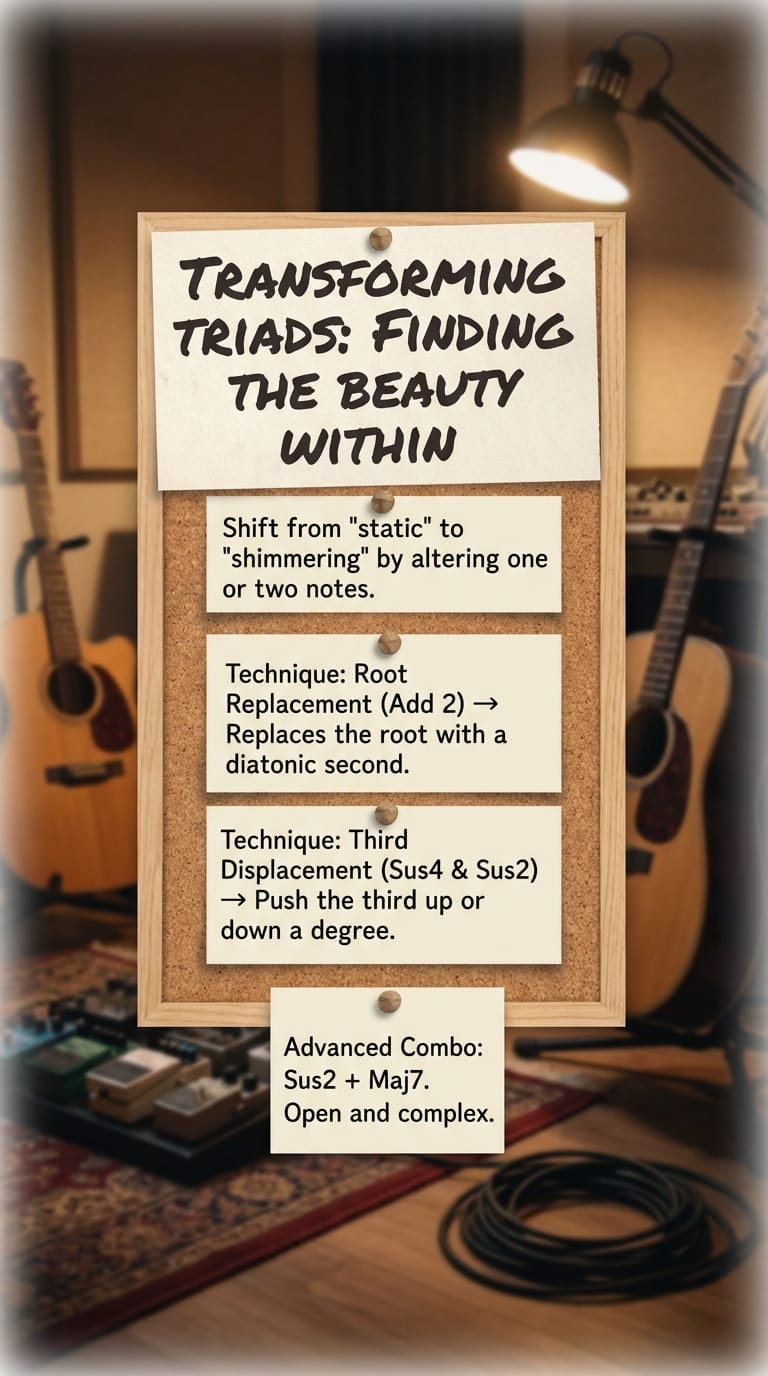
1. Root Replacement for Add2 Voicings
Replacing the root note of a triad with the diatonic second creates instant harmonic richness. When you take a C major triad and replace the C with D, you get an add2 voicing that brings warmth without muddiness.
Week 1: Practice root replacement on C, F, and G major triads only – 5 minutes daily
Week 2: Apply to all diatonic triads in C major, noting the phrygian color on E minor – 7 minutes daily
Week 3: Use in ii-V-I progressions, holding each voicing for 2 beats – 10 minutes daily
Pro tip: The phrygian sound on the third degree creates beautiful tension for Spanish or modal music
2. Sus4 Voicings Through Third Modification
Raising the third of any triad by a diatonic step creates sus4 voicings with distinctive modal characteristics. This technique produces a lydian sound on the IV chord and locrian colors on the vii° chord.
Step 1: Master the sus4 shape on C major first – practice for 3 days
Step 2: Move diatonically through all seven chords, spending extra time on F (lydian) – 5 days
Step 3: Combine sus4 with regular triads in progressions – practice for 1 week
Expected outcome: Smooth voice leading between standard and sus4 voicings within 2 weeks
Want the full system? The Ultimate Roadmap to Fretboard Freedom turns this concept into a complete path. Learn more here
3. Sus2 Voicings for Modern Tension
Lowering the third creates sus2 voicings that work brilliantly in contemporary music. The tritone intervals that appear on certain degrees add sophisticated tension without overwhelming the harmony.
Days 1-3: Focus only on C and G sus2 shapes – 10 minutes per session
Days 4-7: Add the E minor position with its tritone tension – 15 minutes daily
Week 2: Apply to complete progressions, alternating between sus2 and sus4 – 20 minutes daily
Measurable outcome: Play any pop song with sus2 substitutions by week 3
4. Combined Modifications for Jazz Extensions
The most advanced technique involves modifying both the third and fifth simultaneously. Lower the third to create a sus2 while raising the fifth to a major seventh for lush, extended harmonies.
Week 1: Practice the double modification on C major only – 5 minutes, 3x daily
Week 2: Apply to vi-ii-V-I progressions in three keys – 10 minutes morning and evening
Week 3: Combine all four techniques in one progression – 15 minutes daily
Week 4: Improvise freely mixing all voicing types – 20 minutes daily
Success indicator: Seamlessly voice lead through “All The Things You Are” using all techniques
03 25-Minute Daily Triad Transformation Routine
Warm-up (5 minutes):
Play basic C, F, and G triads in root position, then first and second inversions. Focus on clean fingering and transitions.
Root Replacement Practice (5 minutes):
Move diatonically through all seven chords using add2 voicings. Play each for 4 beats at 60 BPM, noting the modal colors that emerge.
Sus4 Exploration (5 minutes):
Practice sus4 voicings through the same diatonic progression. Spend extra time on the F lydian and B diminished locrian sounds.
Work through sus2 shapes, emphasizing the tritone tensions on E minor and B diminished. Practice resolving these tensions smoothly.
Progression Integration (5 minutes):
Apply all techniques to a ii-V-I in three different keys. Mix voicing types: sus4 on ii, root replacement on V, combined modification on I.
04 Advanced Performance Tips
- Voice Leading Priority: Always prioritize smooth voice leading over complex voicings – a simple sus2 moving stepwise beats a jarring jump to an extended chord
- Modal Awareness: Recognize that each modification creates different modal flavors – use phrygian tensions for Spanish music, lydian for dreamy passages
- Dynamic Control: Play modified voicings slightly softer than regular triads to maintain balance in ensemble settings
- Rhythmic Placement: Place your most colorful voicings on weak beats initially, then gradually move them to stronger positions as your ear develops
- Genre Adaptation: Use root replacement heavily in folk and pop, sus4 in rock, sus2 in modern indie, and combined modifications in jazz
- Tension and Release: Create musical phrases by moving from modified voicings (tension) back to standard triads (release) every 2-4 measures
- Fingering Efficiency: Develop anchor finger technique where at least one finger stays in place between voicing changes
- Listening Development: Record yourself playing these voicings and listen back to internalize their unique colors and emotional qualities
Frequently Asked Questions
How do I turn basic triads into beautiful sounding chords on guitar?
Try This
Over Autumn Leaves changes (Am7, D7, Gmaj7, Cmaj7, F#m7b5, B7, Em), play only triads through the form. Use one string set for the entire A section, then switch to a different string set for the B section. Aim for the smoothest voice leading between each chord.
Replace the root note with the diatonic second above to create add2 voicings, or raise the third by one diatonic step for sus4 sounds. These modifications work on any triad in any key, instantly adding harmonic richness. Within 2-3 weeks of daily practice, you’ll naturally hear where these substitutions fit best. The key is moving these shapes diatonically through all seven chords to discover unique colors like the phrygian sound on the third degree or lydian on the fourth.
What’s the best way to practice triad modifications for chord progressions?
How long does it take to master beautiful chord voicings from triads?
With 20-25 minutes of focused daily practice, you can internalize the four main modifications within 3-4 weeks. Basic proficiency comes after 2 weeks where you’ll play them slowly but accurately. By week 4, you’ll start combining techniques fluidly. After 2 months, these voicings become second nature and you’ll automatically hear opportunities to use them in any musical context.
Why does my sus4 voicing sound wrong on certain chords?
Sus4 voicings create different intervallic relationships depending on the underlying chord quality. On the IV chord (F in C major), you get a beautiful lydian sound due to the #4 interval. On the vii° chord, you’ll hear locrian darkness from the b2 interval. These aren’t wrong – they’re modal colors that work brilliantly in specific contexts. Use lydian sus4 for ethereal, floating sections and locrian sus4 for tension before resolution.
What’s the difference between sus2 and add2 chord voicings?
Add2 voicings keep the third and add the second, creating a fuller sound with the complete triad plus extension. Sus2 removes the third entirely and replaces it with the second, creating an open, ambiguous quality. Add2 works better for tonal music where you need clear major/minor definition. Sus2 excels in modern pop and indie where harmonic ambiguity creates atmosphere. Practice both to understand when each serves the music best.
How do I improvise with modified triad voicings?
What’s the fastest way to apply triad voicings to jazz standards?
Begin with “All The Things You Are” since it contains multiple ii-V-I progressions perfect for practicing modifications. Apply sus4 to all minor ii chords, root replacement to dominant V chords, and combined modifications to major I chords. Practice this formula for one week at 60 BPM. By week 2, you’ll naturally hear where to place these voicings in other standards. This systematic approach works because jazz standards share similar harmonic patterns.
How do I know which triad modification to use when accompanying?
Listen to the melody line first – if it contains the third, avoid sus voicings that would clash. Use root replacement when the bass player is active to avoid doubling. Apply sus4 when moving to a dominant chord for smooth voice leading. Sus2 works beautifully under sustained melody notes. After practicing with recordings for 3-4 weeks, your ear will instantly recognize which modification complements the musical moment. Trust your developing instincts over rigid rules.
05 Your Next 4 Weeks of Transformation
Week 1: Master root replacement add2 voicings in C, G, and D major. Practice 20 minutes daily moving diatonically through each key. Focus on clean fingering and recognizing the phrygian color on the iii chord.
Week 2: Add sus4 voicings to your practice. Combine them with root replacement in simple progressions. Spend extra time on the lydian IV and locrian vii° sounds. Record yourself to check voice leading smoothness.
Week 3: Integrate sus2 voicings and begin combining all three techniques in ii-V-I progressions. Apply to one jazz standard or pop song daily. Focus on seamless transitions between modification types.
Week 4: Practice the advanced double modification technique (sus2 + major 7th). Improvise freely using all four techniques over backing tracks. Apply everything to three complete songs in different styles.
Remember, transformation doesn’t require talent – it requires consistent, focused practice. These techniques have helped over 5000 students in my online program develop professional-sounding chord voicings. You’re not just learning shapes; you’re developing a new harmonic vocabulary that will color every note you play from this point forward.
Ready to master the complete fretboard? Join thousands of guitarists in the Ultimate Roadmap to Fretboard Freedom →

Keep Exploring
About Daniel Weiss
Berklee-trained jazz fusion guitarist, Guitar Idol 2016 finalist, and praised by Jordan Rudess (Dream Theater). Daniel has taught over 5,000 students worldwide through his Fretboard Freedom Path method. Learn more
