
Master Major Triads: The Ultimate Guide for Guitar Players
Want to learn all major triads on guitar? This guide covers every major triad shape across all four string sets, with inversions, voice leading paths, and practical exercises.
TL;DRHere’s the deal: Master the seven diatonic triads in C major using inversions, two-string patterns, and chromatic approaches. Then start creating actual lines instead of just running arpeggios.In This Guide
- Why Major Triads Guitar Players Must Master
- The Three Major Triads in Every Key
- How to Play Major Triads on Guitar: All Four String Sets
- Major vs Minor vs Diminished: Understanding Triad Types
- Major Triad Shapes: Root Position and Inversions
- How to Memorize Major Triads Across the Fretboard
- Major Triad Patterns for Soloing and Improvisation
- Training Your Ear: Identifying Major and Minor Triads
- Common Progressions Using Major Triads
- Applying Major Triads Over Chord Changes
- Voice Leading Exercise: Connecting Inversions
- A 20-Minute Major Triad Practice Routine
Hi everyone, how’s it going? Today we’re going to talk about triads and how you can start creating lines with them. The first thing we want to do is put a few exercises into your muscle memory to help you create lines and expand your horizons with soloing. Watch this video all the way through, and at the end, I’ll show you how everything connects.
The first thing I want to show you is that when it comes to triads, you just need to be aware of the diatonic degrees in C major. That means: C, D minor, E minor, F, G, A minor, B diminished, back to C. Those are our seven degrees.
The most basic way to approach this is to be able to play these triads on free strings and move up with those shapes. Start with a C major example and move it up in the diatonic degrees. That’s your first step. Then, be able to see that with inversions. For example, if I take this C first inversion triad, be able to move that up as well:
And, of course, start creating arpeggios and lines with them. Another way to play triads is just on two strings. For example, if you only use the A string and D string, you can create these arpeggios:
First degree, second degree, etc.
If I take another inversion, let’s say the second inversion of C, this would be:
Second inversion of C, B diminished, A minor, G.
You can also play triads and observe them on two strings, not only on free strings. That’s something to think about in practice, as it will influence the way you create lines later and the flow you have on the instrument, especially when playing over chord changes or creating different beautiful sounds, whether diatonic or out-of-key sounds on a one-chord vamp.
Now, just before we move on to the next idea, please make sure to like this video, subscribe, and hit that bell so you don’t miss any of my videos.
Another thing you can start doing to challenge yourself is playing within one position. Instead of going all over the neck looking for stuff, limit yourself to one position. That’s also good for soloing, but that’s another video I’ll tell you about at the end.
All of this is about being able to play the diatonic triads in one position as well as horizontally. Super important if you want to create freedom in your lines.
Another thing you can start doing is adding chromatic approaches. Let’s take this A minor triad on two strings. Instead of just playing it, you can approach it from a half step below and then play it. You can also move that diatonically:
Something you can practice is string skipping. For example, check this out. This is just a C major arpeggio, but if I want a more legato sound, instead of placing this G note here, I can play it on the G string and then skip a string to get this sound:
Then, you can move that and implement it all the way diatonically:
Whenever we’re talking about creating lines, it’s not enough to just play the actual arpeggios. We want to start implementing and combining different notes. For example, I can play this arpeggio, but then I can add some movement, maybe like this:
You see, these are still notes within the scale, but they complement my arpeggio because everything is about diatonic awareness.
If I take this to the next degree:
I’m not really thinking; it’s all in my muscle memory so I can create those lines on the spot.
If you’ve been watching this channel for a while, you know how much I love talking about enclosures. For me, enclosures are like capturing the note with a cage before stating it. In this case, if I want to play this C major arpeggio with string skipping, I can approach it with that cage. This is the enclosure. You can see this is my cage around the note and then the note, and then I can play my arpeggio. So I get this:
And of course, I can do that with any other degree of C major:
That’s exactly why I created the Galactic Modern Guitar Series, where I show all of the different core fundamental elements to solidify your harmonic and melodic awareness and control on guitar. You can learn all the most core elements of music and immediately start applying them to your solos and creating beautiful melodic lines. Check that out in the link in the description below.
Practicing all of this will definitely boost your muscle memory and creativity. But if you want to understand how to create actual phrasing with it, I invite you to check out this arpeggio lesson over here:
01 Why Major Triads Guitar Players Must Master
If you want to move freely across the fretboard and actually outline the harmony in your solos, major triads on guitar are where it all starts. After 20+ years of teaching, I can tell you that the players who sound the most musical are the ones who internalized their triads early. Not scales. Not modes. Triads.
A major triad is just three notes: the root, major third, and perfect fifth. But those three notes contain the DNA of the chord. When you can hear, see, and play major triads in every position and on every string set, something clicks. You stop running scales and start making music.
In this guide, I’ll walk you through everything: how triads work on guitar, all three inversions across four string sets, voice leading between shapes, chromatic approaches, and real practice exercises. Whether you’re stuck in pentatonic boxes or you know some theory but can’t apply it, this is the foundation that ties everything together.
02 The Three Major Triads in Every Key
“In a root position I have a 1-3-5, in a first inversion I have a 3-5-1, and then the second inversion I have a 5-1-3. Three shapes, four string sets, that’s 12 voicings for one chord.”
Daniel Weiss, from a YouTube lesson
In any major key, there are exactly three major triads: the I, IV, and V chords. In C major, that’s C major (C-E-G), F major (F-A-C), and G major (G-B-D). These are the backbone of Western harmony, right? Every pop song, every blues, every jazz standard leans on these three chords.
But here’s where most guitarists get it wrong. They learn these as open chord shapes or barre chords and stop there. The real power comes when you can play each triad in all three inversions, on every string set, anywhere on the neck.
Root position puts the root on the bottom: C-E-G. First inversion puts the third on the bottom: E-G-C. Second inversion puts the fifth on the bottom: G-C-E. Same three notes, three different voicings, three different sounds. Connect them through voice leading, and that’s when the magic happens.
03 How to Play Major Triads on Guitar: All Four String Sets
There are four main string sets for triads on guitar, and you need to be comfortable on all of them. Most players only practice on one or two string sets and wonder why they feel stuck.
Strings 4-3-2 (D-G-B): Where most people start. The shapes are comfortable, the sound sits in the middle register. A C major root position triad: C (10th fret, 4th string), E (9th fret, 3rd string), G (8th fret, 2nd string). Practice all seven diatonic triads in C major here.
Strings 3-2-1 (G-B-E): Your “bright” triads. Higher register, more cutting. Great for melodic soloing. The tuning irregularity between G and B strings means the shapes differ from strings 4-3-2, so you’re learning genuinely new fretboard visualization patterns.
Strings 5-4-3 (A-D-G): Lower register triads with a warmer, fuller sound. Incredible for comping behind a singer or another soloist.
Strings 6-5-4 (E-A-D): Bass register triads. Thick and powerful. Essential for rhythm guitar. Combine a triad on 6-5-4 with one on 3-2-1 for a massive six-note voicing.
The exercise: take C major, play all three inversions on each string set. That’s 12 shapes for one chord. Do it for all seven diatonic chords: 84 shapes total. Spend a week on each string set.
04 Major vs Minor vs Diminished: Understanding Triad Types
Four types of triads: major, minor, diminished, and augmented. A major triad is root, major 3rd, perfect 5th (4 semitones + 3). Minor is root, minor 3rd, perfect 5th (3 + 4). Diminished is root, minor 3rd, diminished 5th (3 + 3). Augmented is root, major 3rd, augmented 5th (4 + 4).
In C major, the quality follows a fixed pattern: C (major), Dm (minor), Em (minor), F (major), G (major), Am (minor), Bdim (diminished). This pattern is the same in every key. Memorize it, and you can instantly tell which chords are major and minor anywhere.
When you’re soloing, triad quality tells you which notes to target. Over Dm, target D-F-A. Over F, target F-A-C. This is how you start using triads in your guitar solos instead of running scales.
05 Major Triad Shapes: Root Position and Inversions
For each string set, learn three shapes: root position (root on lowest string), first inversion (3rd on lowest), second inversion (5th on lowest).
On strings 4-3-2 in C: Root position is C (10th fret, 4th string), E (9th fret, 3rd), G (8th fret, 2nd). A small diagonal shape. First inversion: E (2nd fret, 4th string), G (open, 3rd string), C (1st fret, 2nd). Second inversion: G, C, E all at the 5th fret. A straight barre. Cool shape, right?
Once you know these three shapes for C major, slide them diatonically through the key. Root position C becomes root position Dm by moving each note to the next scale degree. This is how you build triad voicings that transform your chord progressions.
06 How to Memorize Major Triads Across the Fretboard
No shortcut to memorizing triads, but there’s a system. First, think in terms of the root note. Someone says “play C major triad” – your brain should light up with every C note on the fretboard. That’s your root position starting point. Where’s the E and G closest to that C?
Second, one string set per week. Week one: strings 4-3-2, all seven diatonic triads, all three inversions. Week two: strings 3-2-1. By week four, you’ve covered the whole neck. By week eight, it feels natural.
Third, and most people skip this: practice connecting triads, not playing them in isolation. C major root position, then voice lead to Dm first inversion, then Em second inversion. Isolated shapes are exercises. Connected triads are music.
07 Major Triad Patterns for Soloing and Improvisation
Once you’ve got the shapes memorized, turn them into musical patterns for improvising on guitar.
Ascending and descending arpeggios: Play through the triad from root to 5th and back. Over C: C-E-G-E-C. Do this across string sets and positions.
Two-string patterns: Play triads on just two strings. On A and D strings, a C major triad arpeggio spans several frets with a linear, horn-like sound. This forces horizontal thinking.
String-skipping: Skip a string between triad notes. The wider intervals create an open, modern sound. Think Kurt Rosenwinkel, Pat Metheny.
Chromatic approaches: Approach each triad tone from a half step below. Instead of C-E-G, play B-C, Eb-E, Gb-G. This adds a bebop flavor to your triad lines and creates tension-resolution that sounds incredibly sophisticated.
08 Training Your Ear: Identifying Major and Minor Triads
Being able to hear the difference between major and minor triads is just as important as playing them. The major triad sounds bright and resolved. Minor sounds darker, more introspective. Play a C major triad, then C minor (lower E to Eb). Feel the difference.
Ear training exercise: play a random triad anywhere on the neck without looking. Then identify: major? Minor? Diminished? The goal is instant recognition so when you hear a triad in a song, you know what it is before theory catches up.
This skill directly feeds your improvisation. When you hear the quality of each chord as it passes in a progression, you target the right triad shapes without thinking. Instinct, not calculation.
09 Common Progressions Using Major Triads
Here are real progressions to practice with, covering the most common harmonic movements.
I-IV-V (C-F-G): Foundation of rock, blues, pop. Voice lead between these three major triads on each string set. Goal: smallest possible finger movement between chords.
I-vi-IV-V (C-Am-F-G): The classic “50s progression.” C and Am share C and E. Am and F share A and C. F and G share no notes – that’s where inversions matter most.
ii-V-I (Dm-G-C): The most important jazz progression. On strings 4-3-2: Dm first inversion (F-A-D), G second inversion (D-G-B), C root position (C-E-G). Beautiful descending voice leading. Pure triads.
I-vi-ii-V (C-Am-Dm-G): The full turnaround. Hundreds of standards and pop tunes. Practice as a cycle on all four string sets. Record yourself – does it sound connected or like four separate chords? That’s your benchmark.
Try This
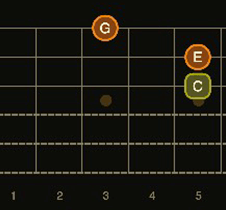
Learn all 3 inversions of G major on the D-G-B strings. Play them ascending up the neck: root position (fret 4-5), first inversion (fret 7-8), second inversion (fret 11-12). Then move to the G-B-E string set and repeat. Voice lead a I-IV-V in G using only close-position triads.


10 Applying Major Triads Over Chord Changes
So here’s where triads stop being an exercise and start being music. When you’re soloing over a chord progression, major triads give you the strongest possible note choices because every note is a chord tone. No filler notes, no passing tones. Just pure harmony.
Let’s take a common progression in C major: C, Am, F, G. Over the C chord, play C major triad arpeggios (C, E, G) in whatever position you’re in. When the chord moves to Am, switch to A minor triad (A, C, E). Notice something? Two of the three notes are shared between C major and A minor. That’s why this progression sounds so smooth, and it’s why voice leading between triads works so well.
Over the F chord, play F major triad (F, A, C). Over G, play G major triad (G, B, D). If you can do this on one string set without jumping all over the neck, you’re already making music that outlines the harmony. And that’s the whole goal: making the chord changes audible in your melodic lines.
Now here’s where it gets interesting. You don’t have to use the “obvious” triad. Over a C major chord, you could play an E minor triad (E, G, B). Those are the 3rd, 5th, and 7th of Cmaj7. Suddenly your triad-based line sounds like a jazz player outlining extensions, but all you’re doing is playing a minor triad. That’s the beauty of this approach.
Put on a backing track with a I-IV-V in G (G, C, D). Solo using only the major triad of each chord. Stay on strings 3-2-1 and voice lead between inversions. When you can make this sound like actual music rather than an exercise, you’ve internalized the concept.
11 Voice Leading Exercise: Connecting Inversions
This is one of the most important exercises I give to my students, and it’s deceptively simple. Pick two chords that are next to each other in a progression. Let’s use C major to G major on strings 4-3-2.
Start with C major root position: C (10th fret), E (9th fret), G (8th fret). Now find the G major inversion that’s closest. Second inversion of G is D (12th fret), G (12th fret), B (12th fret). Each voice moves up by 2, 3, and 4 frets respectively. Not bad, but can we do better?
Try this instead. Start with C major first inversion: E (2nd fret, 4th string), G (open, 3rd string), C (1st fret, 2nd string). Move to G major root position: G (5th fret, 4th string), B (4th fret, 3rd string), D (3rd fret, 2nd string). Each voice moves up by about three frets. Still not minimal voice leading.
The smoothest option: C major second inversion at G (5th fret, 4th string), C (5th fret, 3rd string), E (5th fret, 2nd string). To G major root position: G (5th fret, 4th string), B (4th fret, 3rd string), D (3rd fret, 2nd string). Now the top voice (G) stays, while the other two drop by one fret each. That’s smooth voice leading. That’s the sound of music flowing.
Write out the diatonic triads of C major: C, Dm, Em, F, G, Am, Bdim. On strings 4-3-2, voice lead from each chord to the next, always choosing the inversion that creates the smoothest movement. Record it. This should sound like a beautiful, connected melody, not like separate chords.
12 A 20-Minute Major Triad Practice Routine
Here’s a structured routine that will genuinely transform how you see and use major triads. Do this daily for a month and you’ll notice a massive difference in your playing.
Minutes 1-5: Triad Identification. Pick a random string set (say strings 5-4-3). Play through all seven diatonic triads in C major, naming each chord as you play it. Use one inversion the whole way through. Tomorrow, use a different inversion. This builds automatic recognition.
Minutes 5-10: Voice Leading Chains. Pick a progression. Let’s say Autumn Leaves: Cm, F7, Bbmaj7, Ebmaj7, Am7b5, D7, Gm. Voice lead through the triads of each chord on one string set. Use the triad that’s closest to where you just were. The goal is minimal movement between chords.
Minutes 10-15: Triad Arpeggios as Melodies. Put on a one-chord backing track (say a Cmaj7 vamp). Create melodic phrases using only C major triad notes across multiple string sets. Add rhythm. Add space. Make it musical. The constraint of three notes forces you to be creative with rhythm and phrasing.
Minutes 15-20: Free Application. Put on a backing track with changes (a jazz blues, a ii-V-I, whatever you’re working on). Solo using triads as your primary tool. You can add passing tones and chromatic approaches, but always think of triads as your targets. Every phrase should resolve to a chord tone.
Keep a practice log for this routine. After two weeks, record yourself soloing over changes using triads. Compare it to a recording from before you started. The difference in harmonic clarity will be obvious. Your solos will outline the harmony instead of floating above it.
Keep Exploring
Berklee-trained jazz fusion guitarist, Guitar Idol 2016 finalist, and praised by Jordan Rudess (Dream Theater). Daniel has taught over 5,000 students worldwide through his Fretboard Freedom Path method. Learn more
Keep Exploring
Frequently Asked Questions
What are the seven diatonic triads in C major and how do I practice them?
The seven diatonic triads in C major are: C major, D minor, E minor, F major, G major, A minor, and B diminished. Start by playing these triads on open strings and move them up the neck using the same shapes, then practice them in inversions to build fluency across the fretboard.
How can I play triads on just two strings instead of three?
You can play triads on two strings like the A string and D string by skipping one string and using specific fingerings for each inversion. This approach helps you create smoother lines with better flow when playing over chord changes or soloing within a single position.
What’s the difference between playing triads horizontally versus in one position?
Playing triads horizontally means moving across the neck using the same shape, while playing in one position means staying in a fixed area and finding all the triads within that space. Mastering both approaches gives you freedom to create lines with different feels and textures.
How do I use chromatic approaches and string skipping to make triad-based lines sound more musical?
You can approach a triad from a half step below before playing it, or skip strings within an arpeggio to create a more legato sound instead of playing consecutive notes. Combining these techniques with diatonic movement helps you craft interesting melodic lines that go beyond basic arpeggio shapes.
Want to learn all major triads on guitar? This guide covers every major triad shape across all four string sets, with inversions, voice leading paths, and practical exercises.
TL;DRHere’s the deal: Master the seven diatonic triads in C major using inversions, two-string patterns, and chromatic approaches. Then start creating actual lines instead of just running arpeggios.In This Guide
- Why Major Triads Guitar Players Must Master
- The Three Major Triads in Every Key
- How to Play Major Triads on Guitar: All Four String Sets
- Major vs Minor vs Diminished: Understanding Triad Types
- Major Triad Shapes: Root Position and Inversions
- How to Memorize Major Triads Across the Fretboard
- Major Triad Patterns for Soloing and Improvisation
- Training Your Ear: Identifying Major and Minor Triads
- Common Progressions Using Major Triads
- Applying Major Triads Over Chord Changes
- Voice Leading Exercise: Connecting Inversions
- A 20-Minute Major Triad Practice Routine
Hi everyone, how’s it going? Today we’re going to talk about triads and how you can start creating lines with them. The first thing we want to do is put a few exercises into your muscle memory to help you create lines and expand your horizons with soloing. Watch this video all the way through, and at the end, I’ll show you how everything connects.
The first thing I want to show you is that when it comes to triads, you just need to be aware of the diatonic degrees in C major. That means: C, D minor, E minor, F, G, A minor, B diminished, back to C. Those are our seven degrees.
The most basic way to approach this is to be able to play these triads on free strings and move up with those shapes. Start with a C major example and move it up in the diatonic degrees. That’s your first step. Then, be able to see that with inversions. For example, if I take this C first inversion triad, be able to move that up as well:
And, of course, start creating arpeggios and lines with them. Another way to play triads is just on two strings. For example, if you only use the A string and D string, you can create these arpeggios:
First degree, second degree, etc.
If I take another inversion, let’s say the second inversion of C, this would be:
Second inversion of C, B diminished, A minor, G.
You can also play triads and observe them on two strings, not only on free strings. That’s something to think about in practice, as it will influence the way you create lines later and the flow you have on the instrument, especially when playing over chord changes or creating different beautiful sounds, whether diatonic or out-of-key sounds on a one-chord vamp.
Now, just before we move on to the next idea, please make sure to like this video, subscribe, and hit that bell so you don’t miss any of my videos.
Another thing you can start doing to challenge yourself is playing within one position. Instead of going all over the neck looking for stuff, limit yourself to one position. That’s also good for soloing, but that’s another video I’ll tell you about at the end.
All of this is about being able to play the diatonic triads in one position as well as horizontally. Super important if you want to create freedom in your lines.
Another thing you can start doing is adding chromatic approaches. Let’s take this A minor triad on two strings. Instead of just playing it, you can approach it from a half step below and then play it. You can also move that diatonically:
Something you can practice is string skipping. For example, check this out. This is just a C major arpeggio, but if I want a more legato sound, instead of placing this G note here, I can play it on the G string and then skip a string to get this sound:
Then, you can move that and implement it all the way diatonically:
Whenever we’re talking about creating lines, it’s not enough to just play the actual arpeggios. We want to start implementing and combining different notes. For example, I can play this arpeggio, but then I can add some movement, maybe like this:
You see, these are still notes within the scale, but they complement my arpeggio because everything is about diatonic awareness.
If I take this to the next degree:
I’m not really thinking; it’s all in my muscle memory so I can create those lines on the spot.
If you’ve been watching this channel for a while, you know how much I love talking about enclosures. For me, enclosures are like capturing the note with a cage before stating it. In this case, if I want to play this C major arpeggio with string skipping, I can approach it with that cage. This is the enclosure. You can see this is my cage around the note and then the note, and then I can play my arpeggio. So I get this:
And of course, I can do that with any other degree of C major:
That’s exactly why I created the Galactic Modern Guitar Series, where I show all of the different core fundamental elements to solidify your harmonic and melodic awareness and control on guitar. You can learn all the most core elements of music and immediately start applying them to your solos and creating beautiful melodic lines. Check that out in the link in the description below.
Practicing all of this will definitely boost your muscle memory and creativity. But if you want to understand how to create actual phrasing with it, I invite you to check out this arpeggio lesson over here:
01 Why Major Triads Guitar Players Must Master
If you want to move freely across the fretboard and actually outline the harmony in your solos, major triads on guitar are where it all starts. After 20+ years of teaching, I can tell you that the players who sound the most musical are the ones who internalized their triads early. Not scales. Not modes. Triads.
A major triad is just three notes: the root, major third, and perfect fifth. But those three notes contain the DNA of the chord. When you can hear, see, and play major triads in every position and on every string set, something clicks. You stop running scales and start making music.
In this guide, I’ll walk you through everything: how triads work on guitar, all three inversions across four string sets, voice leading between shapes, chromatic approaches, and real practice exercises. Whether you’re stuck in pentatonic boxes or you know some theory but can’t apply it, this is the foundation that ties everything together.
02 The Three Major Triads in Every Key
“In a root position I have a 1-3-5, in a first inversion I have a 3-5-1, and then the second inversion I have a 5-1-3. Three shapes, four string sets, that’s 12 voicings for one chord.”
Daniel Weiss, from a YouTube lesson
In any major key, there are exactly three major triads: the I, IV, and V chords. In C major, that’s C major (C-E-G), F major (F-A-C), and G major (G-B-D). These are the backbone of Western harmony, right? Every pop song, every blues, every jazz standard leans on these three chords.
But here’s where most guitarists get it wrong. They learn these as open chord shapes or barre chords and stop there. The real power comes when you can play each triad in all three inversions, on every string set, anywhere on the neck.
Root position puts the root on the bottom: C-E-G. First inversion puts the third on the bottom: E-G-C. Second inversion puts the fifth on the bottom: G-C-E. Same three notes, three different voicings, three different sounds. Connect them through voice leading, and that’s when the magic happens.
03 How to Play Major Triads on Guitar: All Four String Sets
There are four main string sets for triads on guitar, and you need to be comfortable on all of them. Most players only practice on one or two string sets and wonder why they feel stuck.
Strings 4-3-2 (D-G-B): Where most people start. The shapes are comfortable, the sound sits in the middle register. A C major root position triad: C (10th fret, 4th string), E (9th fret, 3rd string), G (8th fret, 2nd string). Practice all seven diatonic triads in C major here.
Strings 3-2-1 (G-B-E): Your “bright” triads. Higher register, more cutting. Great for melodic soloing. The tuning irregularity between G and B strings means the shapes differ from strings 4-3-2, so you’re learning genuinely new fretboard visualization patterns.
Strings 5-4-3 (A-D-G): Lower register triads with a warmer, fuller sound. Incredible for comping behind a singer or another soloist.
Strings 6-5-4 (E-A-D): Bass register triads. Thick and powerful. Essential for rhythm guitar. Combine a triad on 6-5-4 with one on 3-2-1 for a massive six-note voicing.
The exercise: take C major, play all three inversions on each string set. That’s 12 shapes for one chord. Do it for all seven diatonic chords: 84 shapes total. Spend a week on each string set.
04 Major vs Minor vs Diminished: Understanding Triad Types
Four types of triads: major, minor, diminished, and augmented. A major triad is root, major 3rd, perfect 5th (4 semitones + 3). Minor is root, minor 3rd, perfect 5th (3 + 4). Diminished is root, minor 3rd, diminished 5th (3 + 3). Augmented is root, major 3rd, augmented 5th (4 + 4).
In C major, the quality follows a fixed pattern: C (major), Dm (minor), Em (minor), F (major), G (major), Am (minor), Bdim (diminished). This pattern is the same in every key. Memorize it, and you can instantly tell which chords are major and minor anywhere.
When you’re soloing, triad quality tells you which notes to target. Over Dm, target D-F-A. Over F, target F-A-C. This is how you start using triads in your guitar solos instead of running scales.
05 Major Triad Shapes: Root Position and Inversions
For each string set, learn three shapes: root position (root on lowest string), first inversion (3rd on lowest), second inversion (5th on lowest).
On strings 4-3-2 in C: Root position is C (10th fret, 4th string), E (9th fret, 3rd), G (8th fret, 2nd). A small diagonal shape. First inversion: E (2nd fret, 4th string), G (open, 3rd string), C (1st fret, 2nd). Second inversion: G, C, E all at the 5th fret. A straight barre. Cool shape, right?
Once you know these three shapes for C major, slide them diatonically through the key. Root position C becomes root position Dm by moving each note to the next scale degree. This is how you build triad voicings that transform your chord progressions.
06 How to Memorize Major Triads Across the Fretboard
No shortcut to memorizing triads, but there’s a system. First, think in terms of the root note. Someone says “play C major triad” – your brain should light up with every C note on the fretboard. That’s your root position starting point. Where’s the E and G closest to that C?
Second, one string set per week. Week one: strings 4-3-2, all seven diatonic triads, all three inversions. Week two: strings 3-2-1. By week four, you’ve covered the whole neck. By week eight, it feels natural.
Third, and most people skip this: practice connecting triads, not playing them in isolation. C major root position, then voice lead to Dm first inversion, then Em second inversion. Isolated shapes are exercises. Connected triads are music.
07 Major Triad Patterns for Soloing and Improvisation
Once you’ve got the shapes memorized, turn them into musical patterns for improvising on guitar.
Ascending and descending arpeggios: Play through the triad from root to 5th and back. Over C: C-E-G-E-C. Do this across string sets and positions.
Two-string patterns: Play triads on just two strings. On A and D strings, a C major triad arpeggio spans several frets with a linear, horn-like sound. This forces horizontal thinking.
String-skipping: Skip a string between triad notes. The wider intervals create an open, modern sound. Think Kurt Rosenwinkel, Pat Metheny.
Chromatic approaches: Approach each triad tone from a half step below. Instead of C-E-G, play B-C, Eb-E, Gb-G. This adds a bebop flavor to your triad lines and creates tension-resolution that sounds incredibly sophisticated.
08 Training Your Ear: Identifying Major and Minor Triads
Being able to hear the difference between major and minor triads is just as important as playing them. The major triad sounds bright and resolved. Minor sounds darker, more introspective. Play a C major triad, then C minor (lower E to Eb). Feel the difference.
Ear training exercise: play a random triad anywhere on the neck without looking. Then identify: major? Minor? Diminished? The goal is instant recognition so when you hear a triad in a song, you know what it is before theory catches up.
This skill directly feeds your improvisation. When you hear the quality of each chord as it passes in a progression, you target the right triad shapes without thinking. Instinct, not calculation.
09 Common Progressions Using Major Triads
Here are real progressions to practice with, covering the most common harmonic movements.
I-IV-V (C-F-G): Foundation of rock, blues, pop. Voice lead between these three major triads on each string set. Goal: smallest possible finger movement between chords.
I-vi-IV-V (C-Am-F-G): The classic “50s progression.” C and Am share C and E. Am and F share A and C. F and G share no notes – that’s where inversions matter most.
ii-V-I (Dm-G-C): The most important jazz progression. On strings 4-3-2: Dm first inversion (F-A-D), G second inversion (D-G-B), C root position (C-E-G). Beautiful descending voice leading. Pure triads.
I-vi-ii-V (C-Am-Dm-G): The full turnaround. Hundreds of standards and pop tunes. Practice as a cycle on all four string sets. Record yourself – does it sound connected or like four separate chords? That’s your benchmark.
Try This
Learn all 3 inversions of G major on the D-G-B strings. Play them ascending up the neck: root position (fret 4-5), first inversion (fret 7-8), second inversion (fret 11-12). Then move to the G-B-E string set and repeat. Voice lead a I-IV-V in G using only close-position triads.


10 Applying Major Triads Over Chord Changes
So here’s where triads stop being an exercise and start being music. When you’re soloing over a chord progression, major triads give you the strongest possible note choices because every note is a chord tone. No filler notes, no passing tones. Just pure harmony.
Let’s take a common progression in C major: C, Am, F, G. Over the C chord, play C major triad arpeggios (C, E, G) in whatever position you’re in. When the chord moves to Am, switch to A minor triad (A, C, E). Notice something? Two of the three notes are shared between C major and A minor. That’s why this progression sounds so smooth, and it’s why voice leading between triads works so well.
Over the F chord, play F major triad (F, A, C). Over G, play G major triad (G, B, D). If you can do this on one string set without jumping all over the neck, you’re already making music that outlines the harmony. And that’s the whole goal: making the chord changes audible in your melodic lines.
Now here’s where it gets interesting. You don’t have to use the “obvious” triad. Over a C major chord, you could play an E minor triad (E, G, B). Those are the 3rd, 5th, and 7th of Cmaj7. Suddenly your triad-based line sounds like a jazz player outlining extensions, but all you’re doing is playing a minor triad. That’s the beauty of this approach.
Put on a backing track with a I-IV-V in G (G, C, D). Solo using only the major triad of each chord. Stay on strings 3-2-1 and voice lead between inversions. When you can make this sound like actual music rather than an exercise, you’ve internalized the concept.
11 Voice Leading Exercise: Connecting Inversions
This is one of the most important exercises I give to my students, and it’s deceptively simple. Pick two chords that are next to each other in a progression. Let’s use C major to G major on strings 4-3-2.
Start with C major root position: C (10th fret), E (9th fret), G (8th fret). Now find the G major inversion that’s closest. Second inversion of G is D (12th fret), G (12th fret), B (12th fret). Each voice moves up by 2, 3, and 4 frets respectively. Not bad, but can we do better?
Try this instead. Start with C major first inversion: E (2nd fret, 4th string), G (open, 3rd string), C (1st fret, 2nd string). Move to G major root position: G (5th fret, 4th string), B (4th fret, 3rd string), D (3rd fret, 2nd string). Each voice moves up by about three frets. Still not minimal voice leading.
The smoothest option: C major second inversion at G (5th fret, 4th string), C (5th fret, 3rd string), E (5th fret, 2nd string). To G major root position: G (5th fret, 4th string), B (4th fret, 3rd string), D (3rd fret, 2nd string). Now the top voice (G) stays, while the other two drop by one fret each. That’s smooth voice leading. That’s the sound of music flowing.
Write out the diatonic triads of C major: C, Dm, Em, F, G, Am, Bdim. On strings 4-3-2, voice lead from each chord to the next, always choosing the inversion that creates the smoothest movement. Record it. This should sound like a beautiful, connected melody, not like separate chords.
12 A 20-Minute Major Triad Practice Routine
Here’s a structured routine that will genuinely transform how you see and use major triads. Do this daily for a month and you’ll notice a massive difference in your playing.
Minutes 1-5: Triad Identification. Pick a random string set (say strings 5-4-3). Play through all seven diatonic triads in C major, naming each chord as you play it. Use one inversion the whole way through. Tomorrow, use a different inversion. This builds automatic recognition.
Minutes 5-10: Voice Leading Chains. Pick a progression. Let’s say Autumn Leaves: Cm, F7, Bbmaj7, Ebmaj7, Am7b5, D7, Gm. Voice lead through the triads of each chord on one string set. Use the triad that’s closest to where you just were. The goal is minimal movement between chords.
Minutes 10-15: Triad Arpeggios as Melodies. Put on a one-chord backing track (say a Cmaj7 vamp). Create melodic phrases using only C major triad notes across multiple string sets. Add rhythm. Add space. Make it musical. The constraint of three notes forces you to be creative with rhythm and phrasing.
Minutes 15-20: Free Application. Put on a backing track with changes (a jazz blues, a ii-V-I, whatever you’re working on). Solo using triads as your primary tool. You can add passing tones and chromatic approaches, but always think of triads as your targets. Every phrase should resolve to a chord tone.
Keep a practice log for this routine. After two weeks, record yourself soloing over changes using triads. Compare it to a recording from before you started. The difference in harmonic clarity will be obvious. Your solos will outline the harmony instead of floating above it.
Keep Exploring
Berklee-trained jazz fusion guitarist, Guitar Idol 2016 finalist, and praised by Jordan Rudess (Dream Theater). Daniel has taught over 5,000 students worldwide through his Fretboard Freedom Path method. Learn more
Keep Exploring
01 Why Major Triads Guitar Players Must Master
If you want to move freely across the fretboard and actually outline the harmony in your solos, major triads on guitar are where it all starts. After 20+ years of teaching, I can tell you that the players who sound the most musical are the ones who internalized their triads early. Not scales. Not modes. Triads.
A major triad is just three notes: the root, major third, and perfect fifth. But those three notes contain the DNA of the chord. When you can hear, see, and play major triads in every position and on every string set, something clicks. You stop running scales and start making music.
In this guide, I’ll walk you through everything: how triads work on guitar, all three inversions across four string sets, voice leading between shapes, chromatic approaches, and real practice exercises. Whether you’re stuck in pentatonic boxes or you know some theory but can’t apply it, this is the foundation that ties everything together.
02 The Three Major Triads in Every Key
“In a root position I have a 1-3-5, in a first inversion I have a 3-5-1, and then the second inversion I have a 5-1-3. Three shapes, four string sets, that’s 12 voicings for one chord.”
Daniel Weiss, from a YouTube lesson
In any major key, there are exactly three major triads: the I, IV, and V chords. In C major, that’s C major (C-E-G), F major (F-A-C), and G major (G-B-D). These are the backbone of Western harmony, right? Every pop song, every blues, every jazz standard leans on these three chords.
But here’s where most guitarists get it wrong. They learn these as open chord shapes or barre chords and stop there. The real power comes when you can play each triad in all three inversions, on every string set, anywhere on the neck.
Root position puts the root on the bottom: C-E-G. First inversion puts the third on the bottom: E-G-C. Second inversion puts the fifth on the bottom: G-C-E. Same three notes, three different voicings, three different sounds. Connect them through voice leading, and that’s when the magic happens.
03 How to Play Major Triads on Guitar: All Four String Sets
There are four main string sets for triads on guitar, and you need to be comfortable on all of them. Most players only practice on one or two string sets and wonder why they feel stuck.
Strings 4-3-2 (D-G-B): Where most people start. The shapes are comfortable, the sound sits in the middle register. A C major root position triad: C (10th fret, 4th string), E (9th fret, 3rd string), G (8th fret, 2nd string). Practice all seven diatonic triads in C major here.
Strings 3-2-1 (G-B-E): Your “bright” triads. Higher register, more cutting. Great for melodic soloing. The tuning irregularity between G and B strings means the shapes differ from strings 4-3-2, so you’re learning genuinely new fretboard visualization patterns.
Strings 5-4-3 (A-D-G): Lower register triads with a warmer, fuller sound. Incredible for comping behind a singer or another soloist.
Strings 6-5-4 (E-A-D): Bass register triads. Thick and powerful. Essential for rhythm guitar. Combine a triad on 6-5-4 with one on 3-2-1 for a massive six-note voicing.
The exercise: take C major, play all three inversions on each string set. That’s 12 shapes for one chord. Do it for all seven diatonic chords: 84 shapes total. Spend a week on each string set.
04 Major vs Minor vs Diminished: Understanding Triad Types
Four types of triads: major, minor, diminished, and augmented. A major triad is root, major 3rd, perfect 5th (4 semitones + 3). Minor is root, minor 3rd, perfect 5th (3 + 4). Diminished is root, minor 3rd, diminished 5th (3 + 3). Augmented is root, major 3rd, augmented 5th (4 + 4).
In C major, the quality follows a fixed pattern: C (major), Dm (minor), Em (minor), F (major), G (major), Am (minor), Bdim (diminished). This pattern is the same in every key. Memorize it, and you can instantly tell which chords are major and minor anywhere.
When you’re soloing, triad quality tells you which notes to target. Over Dm, target D-F-A. Over F, target F-A-C. This is how you start using triads in your guitar solos instead of running scales.
05 Major Triad Shapes: Root Position and Inversions
For each string set, learn three shapes: root position (root on lowest string), first inversion (3rd on lowest), second inversion (5th on lowest).
On strings 4-3-2 in C: Root position is C (10th fret, 4th string), E (9th fret, 3rd), G (8th fret, 2nd). A small diagonal shape. First inversion: E (2nd fret, 4th string), G (open, 3rd string), C (1st fret, 2nd). Second inversion: G, C, E all at the 5th fret. A straight barre. Cool shape, right?
Once you know these three shapes for C major, slide them diatonically through the key. Root position C becomes root position Dm by moving each note to the next scale degree. This is how you build triad voicings that transform your chord progressions.
06 How to Memorize Major Triads Across the Fretboard
No shortcut to memorizing triads, but there’s a system. First, think in terms of the root note. Someone says “play C major triad” – your brain should light up with every C note on the fretboard. That’s your root position starting point. Where’s the E and G closest to that C?
Second, one string set per week. Week one: strings 4-3-2, all seven diatonic triads, all three inversions. Week two: strings 3-2-1. By week four, you’ve covered the whole neck. By week eight, it feels natural.
Third, and most people skip this: practice connecting triads, not playing them in isolation. C major root position, then voice lead to Dm first inversion, then Em second inversion. Isolated shapes are exercises. Connected triads are music.
07 Major Triad Patterns for Soloing and Improvisation
Once you’ve got the shapes memorized, turn them into musical patterns for improvising on guitar.
Ascending and descending arpeggios: Play through the triad from root to 5th and back. Over C: C-E-G-E-C. Do this across string sets and positions.
Two-string patterns: Play triads on just two strings. On A and D strings, a C major triad arpeggio spans several frets with a linear, horn-like sound. This forces horizontal thinking.
String-skipping: Skip a string between triad notes. The wider intervals create an open, modern sound. Think Kurt Rosenwinkel, Pat Metheny.
Chromatic approaches: Approach each triad tone from a half step below. Instead of C-E-G, play B-C, Eb-E, Gb-G. This adds a bebop flavor to your triad lines and creates tension-resolution that sounds incredibly sophisticated.
08 Training Your Ear: Identifying Major and Minor Triads
Being able to hear the difference between major and minor triads is just as important as playing them. The major triad sounds bright and resolved. Minor sounds darker, more introspective. Play a C major triad, then C minor (lower E to Eb). Feel the difference.
Ear training exercise: play a random triad anywhere on the neck without looking. Then identify: major? Minor? Diminished? The goal is instant recognition so when you hear a triad in a song, you know what it is before theory catches up.
This skill directly feeds your improvisation. When you hear the quality of each chord as it passes in a progression, you target the right triad shapes without thinking. Instinct, not calculation.
09 Common Progressions Using Major Triads
Here are real progressions to practice with, covering the most common harmonic movements.
I-IV-V (C-F-G): Foundation of rock, blues, pop. Voice lead between these three major triads on each string set. Goal: smallest possible finger movement between chords.
I-vi-IV-V (C-Am-F-G): The classic “50s progression.” C and Am share C and E. Am and F share A and C. F and G share no notes – that’s where inversions matter most.
ii-V-I (Dm-G-C): The most important jazz progression. On strings 4-3-2: Dm first inversion (F-A-D), G second inversion (D-G-B), C root position (C-E-G). Beautiful descending voice leading. Pure triads.
I-vi-ii-V (C-Am-Dm-G): The full turnaround. Hundreds of standards and pop tunes. Practice as a cycle on all four string sets. Record yourself – does it sound connected or like four separate chords? That’s your benchmark.
Try This
Learn all 3 inversions of G major on the D-G-B strings. Play them ascending up the neck: root position (fret 4-5), first inversion (fret 7-8), second inversion (fret 11-12). Then move to the G-B-E string set and repeat. Voice lead a I-IV-V in G using only close-position triads.


10 Applying Major Triads Over Chord Changes
So here’s where triads stop being an exercise and start being music. When you’re soloing over a chord progression, major triads give you the strongest possible note choices because every note is a chord tone. No filler notes, no passing tones. Just pure harmony.
Let’s take a common progression in C major: C, Am, F, G. Over the C chord, play C major triad arpeggios (C, E, G) in whatever position you’re in. When the chord moves to Am, switch to A minor triad (A, C, E). Notice something? Two of the three notes are shared between C major and A minor. That’s why this progression sounds so smooth, and it’s why voice leading between triads works so well.
Over the F chord, play F major triad (F, A, C). Over G, play G major triad (G, B, D). If you can do this on one string set without jumping all over the neck, you’re already making music that outlines the harmony. And that’s the whole goal: making the chord changes audible in your melodic lines.
Now here’s where it gets interesting. You don’t have to use the “obvious” triad. Over a C major chord, you could play an E minor triad (E, G, B). Those are the 3rd, 5th, and 7th of Cmaj7. Suddenly your triad-based line sounds like a jazz player outlining extensions, but all you’re doing is playing a minor triad. That’s the beauty of this approach.
Put on a backing track with a I-IV-V in G (G, C, D). Solo using only the major triad of each chord. Stay on strings 3-2-1 and voice lead between inversions. When you can make this sound like actual music rather than an exercise, you’ve internalized the concept.
11 Voice Leading Exercise: Connecting Inversions
This is one of the most important exercises I give to my students, and it’s deceptively simple. Pick two chords that are next to each other in a progression. Let’s use C major to G major on strings 4-3-2.
Start with C major root position: C (10th fret), E (9th fret), G (8th fret). Now find the G major inversion that’s closest. Second inversion of G is D (12th fret), G (12th fret), B (12th fret). Each voice moves up by 2, 3, and 4 frets respectively. Not bad, but can we do better?
Try this instead. Start with C major first inversion: E (2nd fret, 4th string), G (open, 3rd string), C (1st fret, 2nd string). Move to G major root position: G (5th fret, 4th string), B (4th fret, 3rd string), D (3rd fret, 2nd string). Each voice moves up by about three frets. Still not minimal voice leading.
The smoothest option: C major second inversion at G (5th fret, 4th string), C (5th fret, 3rd string), E (5th fret, 2nd string). To G major root position: G (5th fret, 4th string), B (4th fret, 3rd string), D (3rd fret, 2nd string). Now the top voice (G) stays, while the other two drop by one fret each. That’s smooth voice leading. That’s the sound of music flowing.
Write out the diatonic triads of C major: C, Dm, Em, F, G, Am, Bdim. On strings 4-3-2, voice lead from each chord to the next, always choosing the inversion that creates the smoothest movement. Record it. This should sound like a beautiful, connected melody, not like separate chords.
12 A 20-Minute Major Triad Practice Routine
Here’s a structured routine that will genuinely transform how you see and use major triads. Do this daily for a month and you’ll notice a massive difference in your playing.
Minutes 1-5: Triad Identification. Pick a random string set (say strings 5-4-3). Play through all seven diatonic triads in C major, naming each chord as you play it. Use one inversion the whole way through. Tomorrow, use a different inversion. This builds automatic recognition.
Minutes 5-10: Voice Leading Chains. Pick a progression. Let’s say Autumn Leaves: Cm, F7, Bbmaj7, Ebmaj7, Am7b5, D7, Gm. Voice lead through the triads of each chord on one string set. Use the triad that’s closest to where you just were. The goal is minimal movement between chords.
Minutes 10-15: Triad Arpeggios as Melodies. Put on a one-chord backing track (say a Cmaj7 vamp). Create melodic phrases using only C major triad notes across multiple string sets. Add rhythm. Add space. Make it musical. The constraint of three notes forces you to be creative with rhythm and phrasing.
Minutes 15-20: Free Application. Put on a backing track with changes (a jazz blues, a ii-V-I, whatever you’re working on). Solo using triads as your primary tool. You can add passing tones and chromatic approaches, but always think of triads as your targets. Every phrase should resolve to a chord tone.
Keep a practice log for this routine. After two weeks, record yourself soloing over changes using triads. Compare it to a recording from before you started. The difference in harmonic clarity will be obvious. Your solos will outline the harmony instead of floating above it.
Keep Exploring
Berklee-trained jazz fusion guitarist, Guitar Idol 2016 finalist, and praised by Jordan Rudess (Dream Theater). Daniel has taught over 5,000 students worldwide through his Fretboard Freedom Path method. Learn more
Keep Exploring
01 Why Major Triads Guitar Players Must Master
If you want to move freely across the fretboard and actually outline the harmony in your solos, major triads on guitar are where it all starts. After 20+ years of teaching, I can tell you that the players who sound the most musical are the ones who internalized their triads early. Not scales. Not modes. Triads.
A major triad is just three notes: the root, major third, and perfect fifth. But those three notes contain the DNA of the chord. When you can hear, see, and play major triads in every position and on every string set, something clicks. You stop running scales and start making music.
In this guide, I’ll walk you through everything: how triads work on guitar, all three inversions across four string sets, voice leading between shapes, chromatic approaches, and real practice exercises. Whether you’re stuck in pentatonic boxes or you know some theory but can’t apply it, this is the foundation that ties everything together.
02 The Three Major Triads in Every Key
“In a root position I have a 1-3-5, in a first inversion I have a 3-5-1, and then the second inversion I have a 5-1-3. Three shapes, four string sets, that’s 12 voicings for one chord.”
Daniel Weiss, from a YouTube lesson
In any major key, there are exactly three major triads: the I, IV, and V chords. In C major, that’s C major (C-E-G), F major (F-A-C), and G major (G-B-D). These are the backbone of Western harmony, right? Every pop song, every blues, every jazz standard leans on these three chords.
But here’s where most guitarists get it wrong. They learn these as open chord shapes or barre chords and stop there. The real power comes when you can play each triad in all three inversions, on every string set, anywhere on the neck.
Root position puts the root on the bottom: C-E-G. First inversion puts the third on the bottom: E-G-C. Second inversion puts the fifth on the bottom: G-C-E. Same three notes, three different voicings, three different sounds. Connect them through voice leading, and that’s when the magic happens.
03 How to Play Major Triads on Guitar: All Four String Sets
There are four main string sets for triads on guitar, and you need to be comfortable on all of them. Most players only practice on one or two string sets and wonder why they feel stuck.
Strings 4-3-2 (D-G-B): Where most people start. The shapes are comfortable, the sound sits in the middle register. A C major root position triad: C (10th fret, 4th string), E (9th fret, 3rd string), G (8th fret, 2nd string). Practice all seven diatonic triads in C major here.
Strings 3-2-1 (G-B-E): Your “bright” triads. Higher register, more cutting. Great for melodic soloing. The tuning irregularity between G and B strings means the shapes differ from strings 4-3-2, so you’re learning genuinely new fretboard visualization patterns.
Strings 5-4-3 (A-D-G): Lower register triads with a warmer, fuller sound. Incredible for comping behind a singer or another soloist.
Strings 6-5-4 (E-A-D): Bass register triads. Thick and powerful. Essential for rhythm guitar. Combine a triad on 6-5-4 with one on 3-2-1 for a massive six-note voicing.
The exercise: take C major, play all three inversions on each string set. That’s 12 shapes for one chord. Do it for all seven diatonic chords: 84 shapes total. Spend a week on each string set.
04 Major vs Minor vs Diminished: Understanding Triad Types
Four types of triads: major, minor, diminished, and augmented. A major triad is root, major 3rd, perfect 5th (4 semitones + 3). Minor is root, minor 3rd, perfect 5th (3 + 4). Diminished is root, minor 3rd, diminished 5th (3 + 3). Augmented is root, major 3rd, augmented 5th (4 + 4).
In C major, the quality follows a fixed pattern: C (major), Dm (minor), Em (minor), F (major), G (major), Am (minor), Bdim (diminished). This pattern is the same in every key. Memorize it, and you can instantly tell which chords are major and minor anywhere.
When you’re soloing, triad quality tells you which notes to target. Over Dm, target D-F-A. Over F, target F-A-C. This is how you start using triads in your guitar solos instead of running scales.
05 Major Triad Shapes: Root Position and Inversions
For each string set, learn three shapes: root position (root on lowest string), first inversion (3rd on lowest), second inversion (5th on lowest).
On strings 4-3-2 in C: Root position is C (10th fret, 4th string), E (9th fret, 3rd), G (8th fret, 2nd). A small diagonal shape. First inversion: E (2nd fret, 4th string), G (open, 3rd string), C (1st fret, 2nd). Second inversion: G, C, E all at the 5th fret. A straight barre. Cool shape, right?
Once you know these three shapes for C major, slide them diatonically through the key. Root position C becomes root position Dm by moving each note to the next scale degree. This is how you build triad voicings that transform your chord progressions.
06 How to Memorize Major Triads Across the Fretboard
No shortcut to memorizing triads, but there’s a system. First, think in terms of the root note. Someone says “play C major triad” – your brain should light up with every C note on the fretboard. That’s your root position starting point. Where’s the E and G closest to that C?
Second, one string set per week. Week one: strings 4-3-2, all seven diatonic triads, all three inversions. Week two: strings 3-2-1. By week four, you’ve covered the whole neck. By week eight, it feels natural.
Third, and most people skip this: practice connecting triads, not playing them in isolation. C major root position, then voice lead to Dm first inversion, then Em second inversion. Isolated shapes are exercises. Connected triads are music.
07 Major Triad Patterns for Soloing and Improvisation
Once you’ve got the shapes memorized, turn them into musical patterns for improvising on guitar.
Ascending and descending arpeggios: Play through the triad from root to 5th and back. Over C: C-E-G-E-C. Do this across string sets and positions.
Two-string patterns: Play triads on just two strings. On A and D strings, a C major triad arpeggio spans several frets with a linear, horn-like sound. This forces horizontal thinking.
String-skipping: Skip a string between triad notes. The wider intervals create an open, modern sound. Think Kurt Rosenwinkel, Pat Metheny.
Chromatic approaches: Approach each triad tone from a half step below. Instead of C-E-G, play B-C, Eb-E, Gb-G. This adds a bebop flavor to your triad lines and creates tension-resolution that sounds incredibly sophisticated.
08 Training Your Ear: Identifying Major and Minor Triads
Being able to hear the difference between major and minor triads is just as important as playing them. The major triad sounds bright and resolved. Minor sounds darker, more introspective. Play a C major triad, then C minor (lower E to Eb). Feel the difference.
Ear training exercise: play a random triad anywhere on the neck without looking. Then identify: major? Minor? Diminished? The goal is instant recognition so when you hear a triad in a song, you know what it is before theory catches up.
This skill directly feeds your improvisation. When you hear the quality of each chord as it passes in a progression, you target the right triad shapes without thinking. Instinct, not calculation.
09 Common Progressions Using Major Triads
Here are real progressions to practice with, covering the most common harmonic movements.
I-IV-V (C-F-G): Foundation of rock, blues, pop. Voice lead between these three major triads on each string set. Goal: smallest possible finger movement between chords.
I-vi-IV-V (C-Am-F-G): The classic “50s progression.” C and Am share C and E. Am and F share A and C. F and G share no notes – that’s where inversions matter most.
ii-V-I (Dm-G-C): The most important jazz progression. On strings 4-3-2: Dm first inversion (F-A-D), G second inversion (D-G-B), C root position (C-E-G). Beautiful descending voice leading. Pure triads.
I-vi-ii-V (C-Am-Dm-G): The full turnaround. Hundreds of standards and pop tunes. Practice as a cycle on all four string sets. Record yourself – does it sound connected or like four separate chords? That’s your benchmark.
Try This
Learn all 3 inversions of G major on the D-G-B strings. Play them ascending up the neck: root position (fret 4-5), first inversion (fret 7-8), second inversion (fret 11-12). Then move to the G-B-E string set and repeat. Voice lead a I-IV-V in G using only close-position triads.


10 Applying Major Triads Over Chord Changes
So here’s where triads stop being an exercise and start being music. When you’re soloing over a chord progression, major triads give you the strongest possible note choices because every note is a chord tone. No filler notes, no passing tones. Just pure harmony.
Let’s take a common progression in C major: C, Am, F, G. Over the C chord, play C major triad arpeggios (C, E, G) in whatever position you’re in. When the chord moves to Am, switch to A minor triad (A, C, E). Notice something? Two of the three notes are shared between C major and A minor. That’s why this progression sounds so smooth, and it’s why voice leading between triads works so well.
Over the F chord, play F major triad (F, A, C). Over G, play G major triad (G, B, D). If you can do this on one string set without jumping all over the neck, you’re already making music that outlines the harmony. And that’s the whole goal: making the chord changes audible in your melodic lines.
Now here’s where it gets interesting. You don’t have to use the “obvious” triad. Over a C major chord, you could play an E minor triad (E, G, B). Those are the 3rd, 5th, and 7th of Cmaj7. Suddenly your triad-based line sounds like a jazz player outlining extensions, but all you’re doing is playing a minor triad. That’s the beauty of this approach.
Put on a backing track with a I-IV-V in G (G, C, D). Solo using only the major triad of each chord. Stay on strings 3-2-1 and voice lead between inversions. When you can make this sound like actual music rather than an exercise, you’ve internalized the concept.
11 Voice Leading Exercise: Connecting Inversions
This is one of the most important exercises I give to my students, and it’s deceptively simple. Pick two chords that are next to each other in a progression. Let’s use C major to G major on strings 4-3-2.
Start with C major root position: C (10th fret), E (9th fret), G (8th fret). Now find the G major inversion that’s closest. Second inversion of G is D (12th fret), G (12th fret), B (12th fret). Each voice moves up by 2, 3, and 4 frets respectively. Not bad, but can we do better?
Try this instead. Start with C major first inversion: E (2nd fret, 4th string), G (open, 3rd string), C (1st fret, 2nd string). Move to G major root position: G (5th fret, 4th string), B (4th fret, 3rd string), D (3rd fret, 2nd string). Each voice moves up by about three frets. Still not minimal voice leading.
The smoothest option: C major second inversion at G (5th fret, 4th string), C (5th fret, 3rd string), E (5th fret, 2nd string). To G major root position: G (5th fret, 4th string), B (4th fret, 3rd string), D (3rd fret, 2nd string). Now the top voice (G) stays, while the other two drop by one fret each. That’s smooth voice leading. That’s the sound of music flowing.
Write out the diatonic triads of C major: C, Dm, Em, F, G, Am, Bdim. On strings 4-3-2, voice lead from each chord to the next, always choosing the inversion that creates the smoothest movement. Record it. This should sound like a beautiful, connected melody, not like separate chords.
12 A 20-Minute Major Triad Practice Routine
Here’s a structured routine that will genuinely transform how you see and use major triads. Do this daily for a month and you’ll notice a massive difference in your playing.
Minutes 1-5: Triad Identification. Pick a random string set (say strings 5-4-3). Play through all seven diatonic triads in C major, naming each chord as you play it. Use one inversion the whole way through. Tomorrow, use a different inversion. This builds automatic recognition.
Minutes 5-10: Voice Leading Chains. Pick a progression. Let’s say Autumn Leaves: Cm, F7, Bbmaj7, Ebmaj7, Am7b5, D7, Gm. Voice lead through the triads of each chord on one string set. Use the triad that’s closest to where you just were. The goal is minimal movement between chords.
Minutes 10-15: Triad Arpeggios as Melodies. Put on a one-chord backing track (say a Cmaj7 vamp). Create melodic phrases using only C major triad notes across multiple string sets. Add rhythm. Add space. Make it musical. The constraint of three notes forces you to be creative with rhythm and phrasing.
Minutes 15-20: Free Application. Put on a backing track with changes (a jazz blues, a ii-V-I, whatever you’re working on). Solo using triads as your primary tool. You can add passing tones and chromatic approaches, but always think of triads as your targets. Every phrase should resolve to a chord tone.
Keep a practice log for this routine. After two weeks, record yourself soloing over changes using triads. Compare it to a recording from before you started. The difference in harmonic clarity will be obvious. Your solos will outline the harmony instead of floating above it.
Keep Exploring
Berklee-trained jazz fusion guitarist, Guitar Idol 2016 finalist, and praised by Jordan Rudess (Dream Theater). Daniel has taught over 5,000 students worldwide through his Fretboard Freedom Path method. Learn more
Keep Exploring
01 Why Major Triads Guitar Players Must Master
If you want to move freely across the fretboard and actually outline the harmony in your solos, major triads on guitar are where it all starts. After 20+ years of teaching, I can tell you that the players who sound the most musical are the ones who internalized their triads early. Not scales. Not modes. Triads.
A major triad is just three notes: the root, major third, and perfect fifth. But those three notes contain the DNA of the chord. When you can hear, see, and play major triads in every position and on every string set, something clicks. You stop running scales and start making music.
In this guide, I’ll walk you through everything: how triads work on guitar, all three inversions across four string sets, voice leading between shapes, chromatic approaches, and real practice exercises. Whether you’re stuck in pentatonic boxes or you know some theory but can’t apply it, this is the foundation that ties everything together.
02 The Three Major Triads in Every Key
“In a root position I have a 1-3-5, in a first inversion I have a 3-5-1, and then the second inversion I have a 5-1-3. Three shapes, four string sets, that’s 12 voicings for one chord.”
Daniel Weiss, from a YouTube lesson
In any major key, there are exactly three major triads: the I, IV, and V chords. In C major, that’s C major (C-E-G), F major (F-A-C), and G major (G-B-D). These are the backbone of Western harmony, right? Every pop song, every blues, every jazz standard leans on these three chords.
But here’s where most guitarists get it wrong. They learn these as open chord shapes or barre chords and stop there. The real power comes when you can play each triad in all three inversions, on every string set, anywhere on the neck.
Root position puts the root on the bottom: C-E-G. First inversion puts the third on the bottom: E-G-C. Second inversion puts the fifth on the bottom: G-C-E. Same three notes, three different voicings, three different sounds. Connect them through voice leading, and that’s when the magic happens.
03 How to Play Major Triads on Guitar: All Four String Sets
There are four main string sets for triads on guitar, and you need to be comfortable on all of them. Most players only practice on one or two string sets and wonder why they feel stuck.
Strings 4-3-2 (D-G-B): Where most people start. The shapes are comfortable, the sound sits in the middle register. A C major root position triad: C (10th fret, 4th string), E (9th fret, 3rd string), G (8th fret, 2nd string). Practice all seven diatonic triads in C major here.
Strings 3-2-1 (G-B-E): Your “bright” triads. Higher register, more cutting. Great for melodic soloing. The tuning irregularity between G and B strings means the shapes differ from strings 4-3-2, so you’re learning genuinely new fretboard visualization patterns.
Strings 5-4-3 (A-D-G): Lower register triads with a warmer, fuller sound. Incredible for comping behind a singer or another soloist.
Strings 6-5-4 (E-A-D): Bass register triads. Thick and powerful. Essential for rhythm guitar. Combine a triad on 6-5-4 with one on 3-2-1 for a massive six-note voicing.
The exercise: take C major, play all three inversions on each string set. That’s 12 shapes for one chord. Do it for all seven diatonic chords: 84 shapes total. Spend a week on each string set.
04 Major vs Minor vs Diminished: Understanding Triad Types
Four types of triads: major, minor, diminished, and augmented. A major triad is root, major 3rd, perfect 5th (4 semitones + 3). Minor is root, minor 3rd, perfect 5th (3 + 4). Diminished is root, minor 3rd, diminished 5th (3 + 3). Augmented is root, major 3rd, augmented 5th (4 + 4).
In C major, the quality follows a fixed pattern: C (major), Dm (minor), Em (minor), F (major), G (major), Am (minor), Bdim (diminished). This pattern is the same in every key. Memorize it, and you can instantly tell which chords are major and minor anywhere.
When you’re soloing, triad quality tells you which notes to target. Over Dm, target D-F-A. Over F, target F-A-C. This is how you start using triads in your guitar solos instead of running scales.
05 Major Triad Shapes: Root Position and Inversions
For each string set, learn three shapes: root position (root on lowest string), first inversion (3rd on lowest), second inversion (5th on lowest).
On strings 4-3-2 in C: Root position is C (10th fret, 4th string), E (9th fret, 3rd), G (8th fret, 2nd). A small diagonal shape. First inversion: E (2nd fret, 4th string), G (open, 3rd string), C (1st fret, 2nd). Second inversion: G, C, E all at the 5th fret. A straight barre. Cool shape, right?
Once you know these three shapes for C major, slide them diatonically through the key. Root position C becomes root position Dm by moving each note to the next scale degree. This is how you build triad voicings that transform your chord progressions.
06 How to Memorize Major Triads Across the Fretboard
No shortcut to memorizing triads, but there’s a system. First, think in terms of the root note. Someone says “play C major triad” – your brain should light up with every C note on the fretboard. That’s your root position starting point. Where’s the E and G closest to that C?
Second, one string set per week. Week one: strings 4-3-2, all seven diatonic triads, all three inversions. Week two: strings 3-2-1. By week four, you’ve covered the whole neck. By week eight, it feels natural.
Third, and most people skip this: practice connecting triads, not playing them in isolation. C major root position, then voice lead to Dm first inversion, then Em second inversion. Isolated shapes are exercises. Connected triads are music.
07 Major Triad Patterns for Soloing and Improvisation
Once you’ve got the shapes memorized, turn them into musical patterns for improvising on guitar.
Ascending and descending arpeggios: Play through the triad from root to 5th and back. Over C: C-E-G-E-C. Do this across string sets and positions.
Two-string patterns: Play triads on just two strings. On A and D strings, a C major triad arpeggio spans several frets with a linear, horn-like sound. This forces horizontal thinking.
String-skipping: Skip a string between triad notes. The wider intervals create an open, modern sound. Think Kurt Rosenwinkel, Pat Metheny.
Chromatic approaches: Approach each triad tone from a half step below. Instead of C-E-G, play B-C, Eb-E, Gb-G. This adds a bebop flavor to your triad lines and creates tension-resolution that sounds incredibly sophisticated.
08 Training Your Ear: Identifying Major and Minor Triads
Being able to hear the difference between major and minor triads is just as important as playing them. The major triad sounds bright and resolved. Minor sounds darker, more introspective. Play a C major triad, then C minor (lower E to Eb). Feel the difference.
Ear training exercise: play a random triad anywhere on the neck without looking. Then identify: major? Minor? Diminished? The goal is instant recognition so when you hear a triad in a song, you know what it is before theory catches up.
This skill directly feeds your improvisation. When you hear the quality of each chord as it passes in a progression, you target the right triad shapes without thinking. Instinct, not calculation.
09 Common Progressions Using Major Triads
Here are real progressions to practice with, covering the most common harmonic movements.
I-IV-V (C-F-G): Foundation of rock, blues, pop. Voice lead between these three major triads on each string set. Goal: smallest possible finger movement between chords.
I-vi-IV-V (C-Am-F-G): The classic “50s progression.” C and Am share C and E. Am and F share A and C. F and G share no notes – that’s where inversions matter most.
ii-V-I (Dm-G-C): The most important jazz progression. On strings 4-3-2: Dm first inversion (F-A-D), G second inversion (D-G-B), C root position (C-E-G). Beautiful descending voice leading. Pure triads.
I-vi-ii-V (C-Am-Dm-G): The full turnaround. Hundreds of standards and pop tunes. Practice as a cycle on all four string sets. Record yourself – does it sound connected or like four separate chords? That’s your benchmark.
Try This
Learn all 3 inversions of G major on the D-G-B strings. Play them ascending up the neck: root position (fret 4-5), first inversion (fret 7-8), second inversion (fret 11-12). Then move to the G-B-E string set and repeat. Voice lead a I-IV-V in G using only close-position triads.


10 Applying Major Triads Over Chord Changes
So here’s where triads stop being an exercise and start being music. When you’re soloing over a chord progression, major triads give you the strongest possible note choices because every note is a chord tone. No filler notes, no passing tones. Just pure harmony.
Let’s take a common progression in C major: C, Am, F, G. Over the C chord, play C major triad arpeggios (C, E, G) in whatever position you’re in. When the chord moves to Am, switch to A minor triad (A, C, E). Notice something? Two of the three notes are shared between C major and A minor. That’s why this progression sounds so smooth, and it’s why voice leading between triads works so well.
Over the F chord, play F major triad (F, A, C). Over G, play G major triad (G, B, D). If you can do this on one string set without jumping all over the neck, you’re already making music that outlines the harmony. And that’s the whole goal: making the chord changes audible in your melodic lines.
Now here’s where it gets interesting. You don’t have to use the “obvious” triad. Over a C major chord, you could play an E minor triad (E, G, B). Those are the 3rd, 5th, and 7th of Cmaj7. Suddenly your triad-based line sounds like a jazz player outlining extensions, but all you’re doing is playing a minor triad. That’s the beauty of this approach.
Put on a backing track with a I-IV-V in G (G, C, D). Solo using only the major triad of each chord. Stay on strings 3-2-1 and voice lead between inversions. When you can make this sound like actual music rather than an exercise, you’ve internalized the concept.
11 Voice Leading Exercise: Connecting Inversions
This is one of the most important exercises I give to my students, and it’s deceptively simple. Pick two chords that are next to each other in a progression. Let’s use C major to G major on strings 4-3-2.
Start with C major root position: C (10th fret), E (9th fret), G (8th fret). Now find the G major inversion that’s closest. Second inversion of G is D (12th fret), G (12th fret), B (12th fret). Each voice moves up by 2, 3, and 4 frets respectively. Not bad, but can we do better?
Try this instead. Start with C major first inversion: E (2nd fret, 4th string), G (open, 3rd string), C (1st fret, 2nd string). Move to G major root position: G (5th fret, 4th string), B (4th fret, 3rd string), D (3rd fret, 2nd string). Each voice moves up by about three frets. Still not minimal voice leading.
The smoothest option: C major second inversion at G (5th fret, 4th string), C (5th fret, 3rd string), E (5th fret, 2nd string). To G major root position: G (5th fret, 4th string), B (4th fret, 3rd string), D (3rd fret, 2nd string). Now the top voice (G) stays, while the other two drop by one fret each. That’s smooth voice leading. That’s the sound of music flowing.
Write out the diatonic triads of C major: C, Dm, Em, F, G, Am, Bdim. On strings 4-3-2, voice lead from each chord to the next, always choosing the inversion that creates the smoothest movement. Record it. This should sound like a beautiful, connected melody, not like separate chords.
12 A 20-Minute Major Triad Practice Routine
Here’s a structured routine that will genuinely transform how you see and use major triads. Do this daily for a month and you’ll notice a massive difference in your playing.
Minutes 1-5: Triad Identification. Pick a random string set (say strings 5-4-3). Play through all seven diatonic triads in C major, naming each chord as you play it. Use one inversion the whole way through. Tomorrow, use a different inversion. This builds automatic recognition.
Minutes 5-10: Voice Leading Chains. Pick a progression. Let’s say Autumn Leaves: Cm, F7, Bbmaj7, Ebmaj7, Am7b5, D7, Gm. Voice lead through the triads of each chord on one string set. Use the triad that’s closest to where you just were. The goal is minimal movement between chords.
Minutes 10-15: Triad Arpeggios as Melodies. Put on a one-chord backing track (say a Cmaj7 vamp). Create melodic phrases using only C major triad notes across multiple string sets. Add rhythm. Add space. Make it musical. The constraint of three notes forces you to be creative with rhythm and phrasing.
Minutes 15-20: Free Application. Put on a backing track with changes (a jazz blues, a ii-V-I, whatever you’re working on). Solo using triads as your primary tool. You can add passing tones and chromatic approaches, but always think of triads as your targets. Every phrase should resolve to a chord tone.
Keep a practice log for this routine. After two weeks, record yourself soloing over changes using triads. Compare it to a recording from before you started. The difference in harmonic clarity will be obvious. Your solos will outline the harmony instead of floating above it.
Keep Exploring
Berklee-trained jazz fusion guitarist, Guitar Idol 2016 finalist, and praised by Jordan Rudess (Dream Theater). Daniel has taught over 5,000 students worldwide through his Fretboard Freedom Path method. Learn more
Keep Exploring