Guitar Mastery: Unlocking Voice Leading for Fluid Improvisation
Introduction
In the realm of musical improvisation, the ability to navigate chord changes with precision and fluidity is paramount. Guitarists, in particular, face the unique challenge of mastering the fretboard’s six linear representations of notes. However, by embracing the art of voice leading, guitarists can transcend these challenges and unlock a new standard of mastery. In this extended exploration, we’ll delve deeper into the transformative power of voice leading for guitar players, emphasizing its role in navigating chord changes, fueling musical ideas, and unlocking creative expression.
Voice Leading as the Foundation of Musical Motion:
At its essence, music is a journey of motion and progression. Whether exploring intervalic leaps, rhythmic motifs, melodic phrases, or emotive expressions, every musical idea is propelled forward by the principles of voice leading.
For guitarists, who must navigate the fretboard’s complex matrix of notes, mastering voice leading is not just a skill—it’s a necessity.
Unlike piano, where notes are laid out in a more spatially intuitive manner, the guitar presents a unique challenge. Guitarists must not only contend with the instrument’s linear representation of notes but also find ways to seamlessly transition between chords and scales across the fretboard. This is where the power of voice leading truly shines.
Navigating Through Changes:
In jazz and other improvisational genres, the concept of “playing through changes” is central to musical expression. Rather than simply playing over chords, skilled musicians weave their improvisations seamlessly through harmonic progressions, creating a sense of continuity and coherence. Voice leading lies at the heart of this process, providing the roadmap for navigating through changes with grace and precision.
By internalizing the principles of voice leading, guitarists gain the ability to anticipate chord changes, identify common harmonic patterns, and intuitively connect disparate musical elements. This newfound fluency allows them to express themselves more freely, transcending the limitations of static scale patterns and unlocking a world of creative possibilities.

The Guitar as a Matrix of Musical Expression:
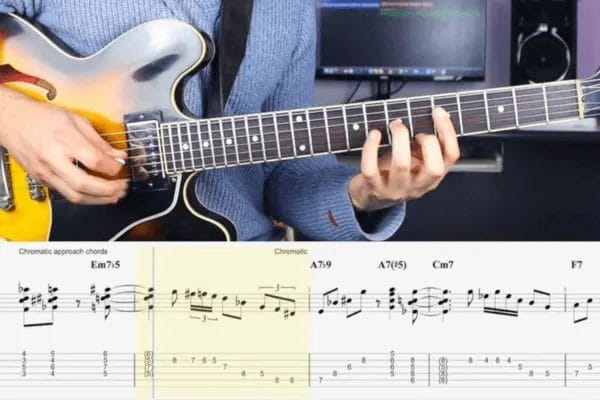
In many ways, the guitar can be viewed as a matrix of musical expression. Its six strings offer a vast landscape for exploration, with each fret representing a potential note or chord voicing. However, without a solid understanding of voice leading principles, this matrix can quickly become overwhelming.
Through diligent practice and study, guitarists can learn to navigate this matrix with confidence and precision. By internalizing the principles of voice leading, they gain the ability to move seamlessly between chords, scales, and melodic ideas, creating fluid, cohesive musical narratives that captivate listeners and fellow musicians alike.
The Journey to Mastery:
On the road to mastery, structured learning and guidance are essential companions. That’s where WeissGuitar.com comes in. Our platform offers a comprehensive curriculum designed to guide aspiring guitarists through every step of their musical journey. From foundational concepts to advanced techniques, each course is crafted with care to provide a rich and rewarding learning experience.
With WeissGuitar.com, you’ll gain access to a wealth of resources, including video lessons, interactive exercises,Guidance and support,. Daniel’s approach ensures that you build a strong foundation while fostering creativity and musicality.
Conclusion:
In conclusion, voice leading represents a new standard of mastery for guitarists seeking to elevate their playing to new heights. By embracing this foundational principle, players can unlock a deeper understanding of musical motion, navigate through changes with ease, and harness the full expressive potential of the guitar as a matrix of musical expression. Whether jamming with friends, performing onstage, or composing original music, the skills acquired through diligent study of voice leading will serve guitarists well on their musical journey.
- Frequently Asked Questions
- How do I stop jumping around the fretboard when improvising over chord changes?
- What’s the difference between playing arpeggios and using voice leading in improvisation?
- Why should I practice E major, C# minor, and F# minor progressions for voice leading?
- Do I need to use inversions to get better at voice leading on guitar?

About Daniel Weiss
Daniel Weiss is a Berklee-trained guitarist, praised by Jordan Rudess (Dream Theater), who has taught improvisation for 20+ years to 5,000+ students worldwide. More about Daniel
Frequently Asked Questions
How do I stop jumping around the fretboard when improvising over chord changes?
Voice leading is the answer – instead of leaping between chord shapes, focus on moving individual notes as smoothly as possible between chords. Practice connecting E major to C# minor to F# minor by moving just one note at a time, which forces you to find the closest path between chord tones rather than hunting for familiar shapes.
What’s the difference between playing arpeggios and using voice leading in improvisation?
Arpeggios outline the individual notes of a chord, while voice leading connects those notes across multiple chords with minimal movement. Voice leading uses chord inversions and strategic note choices to create fluid, singable lines – it’s what transforms stiff arpeggio runs into smooth, musical improvisation.
Why should I practice E major, C# minor, and F# minor progressions for voice leading?
This specific progression teaches you how to move smoothly through related minor and major chords because the shared notes and close intervals force you to find efficient voice leading solutions. Mastering this progression gives you a template for connecting any chord progression smoothly on the fretboard.
Do I need to use inversions to get better at voice leading on guitar?
Yes – chord inversions are essential because they let you keep notes close together and avoid unnecessary jumps across the fretboard. By using root position, first inversion, and second inversion voicings, you’ll discover multiple ways to voice each chord and connect them with minimal movement.


